Freshwater Mussels
Freshwater mussels are the most imperiled group of wildlife in North America. At one time, 80 species made their home in Illinois. Today 17 species are extinct, and 23 are listed as endangered, threatened, or of special concern at the federal or state level. Degraded riverbeds, pollution, and invasive species have all had a part in their decline.
But freshwater mussels provide enormous ecological benefits. As they feed they take in large amounts of water, filtering out bacteria, algae, and other microorganisms before passing clean water back into the waterway. Just one adult can filter up to 18 gallons of water in one day. Because many mussels live in groups, together they can filter enough water to lower overall water pollution levels.
To help these vital aquatic animals recover, the Forest Preserve District is not only working with partner agencies to improve habitat in and around rivers and streams but is also leading the way in breeding species for release into the wild.
Raising Mussels at the Urban Stream Research Center
Since 2012 Forest Preserve District ecologists have been raising freshwater mussels at its Urban Stream Research Center at Blackwell Forest Preserve. The process allows them to increase populations in a relatively short period of time.
The main goal is to raise juveniles to a size that will increase their chances of survival in the wild. Juvenile mussels can be as small as 0.15 millimeter (far too small to see with the naked eye), placing them at risk from aquatic organisms such as hungry flatworms or creatures called “rotifers,” which at only 0.01 millimeter themselves can colonize en masse around juvenile mussels, cutting off their food supply.
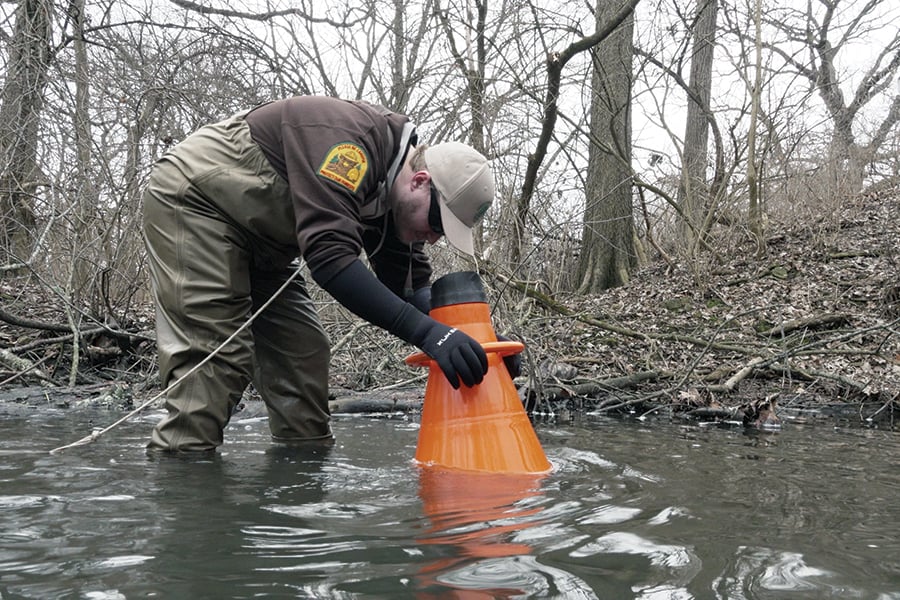
To start, ecologists first need to don waders and slowly move through rivers and streams to find pregnant, or “gravid,” female mussels. By gently prying open the shells they can look for inflated “marsupial gills,” which indicate a mussel is full of larvae called "glochidia."
Of the nine types of mussels that live in DuPage, though, seven are only gravid in winter. This means someone needs to get cold as well as wet. These mussels often burrow in the streambed in winter to avoid near-freezing temperatures, so they can be incredibly hard to find, so ecologists go out in summer to record where they find them, occasionally moving individuals to a certain stretch of a river to ensure they can find them later during the small window when females are gravid, which can be as short as four weeks.
An ecologist from the Urban Stream Research Center looks for gravid freshwater mussels on a chilly February day.
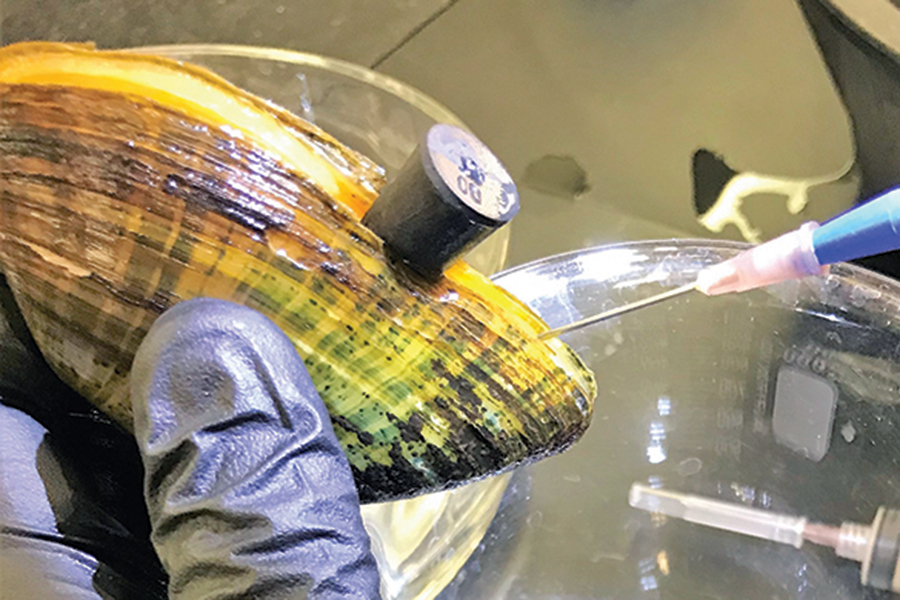
The gravid mussels go to the Urban Stream Research Center, where ecologists then remove and count the glochidia. The most common extraction technique uses water to flush out the marsupial gills, easily removing large amounts of glochidia without causing significant damage to the adult. Ecologists then examine the glochidia under a microscope to make sure they’re fully developed and healthy. A little salt in the observation dish will cause healthy glochidia to quickly snap shut, showing they should be able to successfully latch onto the gills of their host fish when the time comes.
Some glochidia will only attach to the gills of certain species of fish; others are less picky. For common fish such as largemouth bass, smallmouth bass, and yellow perch, the Forest Preserve District can purchase the stock it needs from a hatchery, but for smaller nongame species such as creek chubs, darters, and minnows, it may have to collect the fish from local rivers and streams.
To get glochidia to pair with a host fish, both go in a small water-filled bucket, and the contents is lightly to ensure the microscopic mussels remain suspended. (If they settle on the bottom they’re less likely to come in contact with a fish’s gills.) During this process, the fish are monitored to ensure an ample amount of glochidia have latched on, at which point they go into a larger tank. There, the mussels harmlessly feed off nutrients from their unsuspecting host.
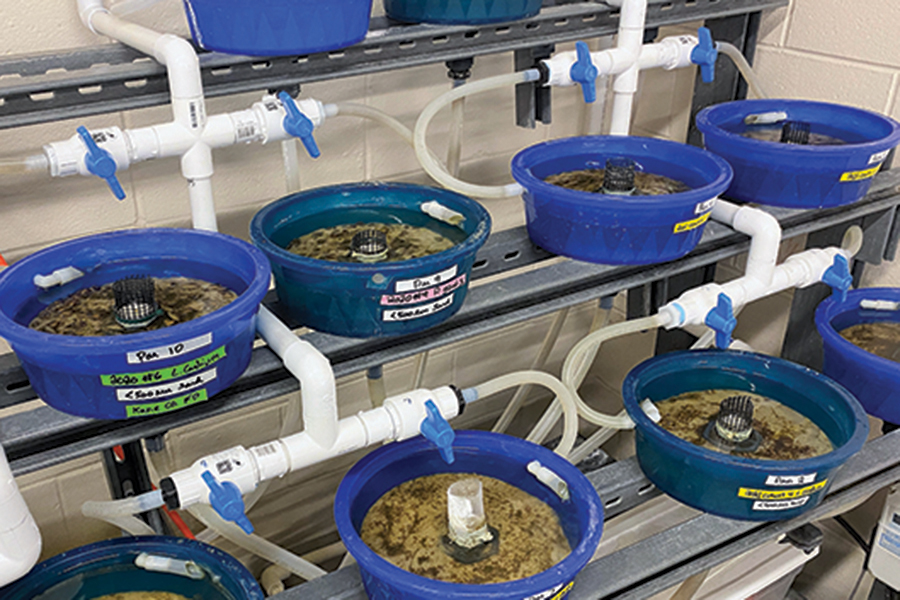
After one to three weeks the mussels’ vital organs fully develop, and they detach. They’re now considered day-old juveniles. They move into specialized pans, each set up with a sandy bottom, water temperature, flow rate, and algae diet that’s appropriate for the particular species. They’re measured weekly and placed in new containers as they grow. Once they reach 2 to 5 millimeters (no bigger than a pencil eraser), though, they’re ready for a more natural environment.
Ecologists use water to gently flush mussel larvae, called “glochidia,” from an adult female elktoe freshwater mussel.
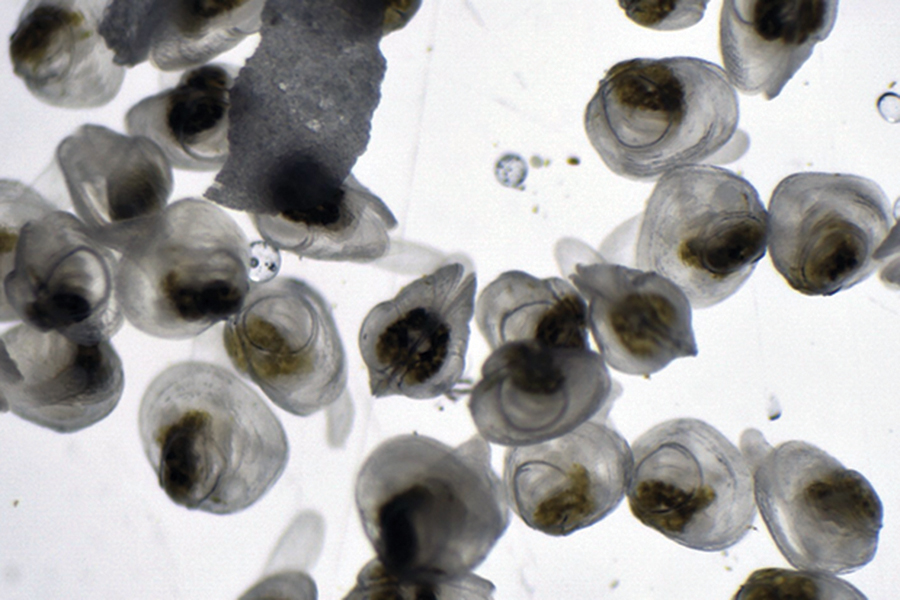
At just a week old, glochidia can only be seen through the lens of a microscope.
Juvenile freshwater mussels spend the first months of their lives in temperature-controlled pans at the Urban Stream Research Center.
For this second-to-last step, ecologists number the mussels and move them into floating containers lined with sand, which go in a spring-fed pond that connects to a river. Staff can still monitor the mussels, but the animals now have a more natural wild-water diet, one they can’t receive in an artificial setting.
After four to six months, the mussels, now “subadults,” measure anywhere from 30 to 60 millimeters (1 to 2.25 inches) and are ready to move into their forever homes along the streambed, where staff will continue to check in on them over the years.
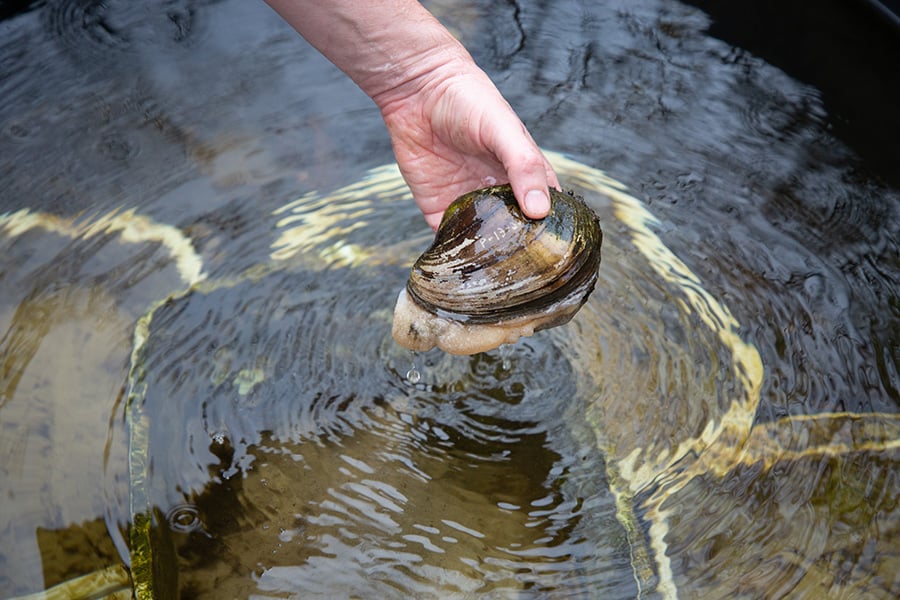
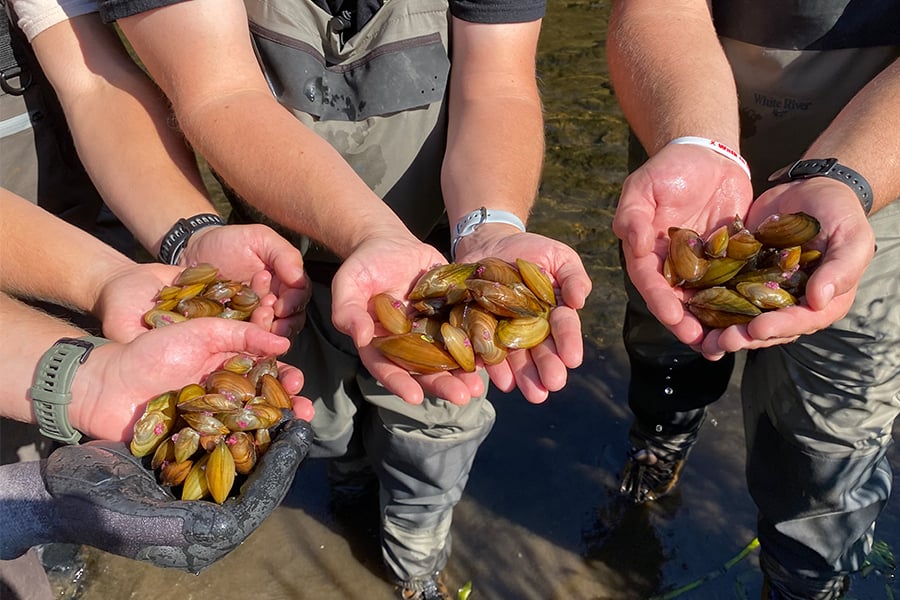
After spending up to two years growing in captivity, these native freshwater mussels are finally large enough to be released into a DuPage river.

About the Research Center
The Urban Stream Research Center is home to the Forest Preserve District's aquatic conservation programs and is the only facility of its kind in Illinois. The building was funded by a grant from the National Oceanic and Atmospheric Administration and is the result of a partnership between DuPage County Stormwater Management and the Forest Preserve District.
The center is not open to the public but does host open houses and school groups throughout the year.
The Marvels of Freshwater Mussels
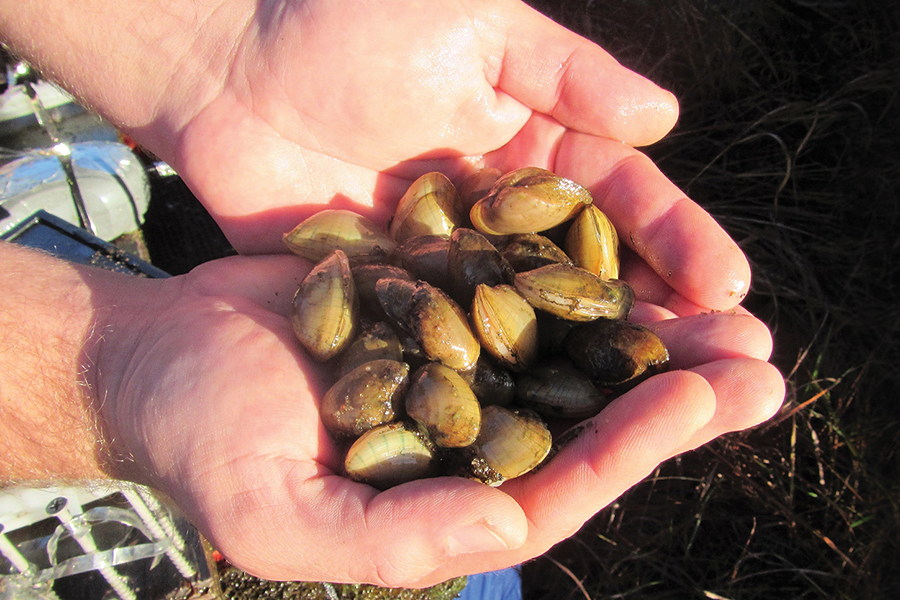
Native freshwater mussels are “bivalved mollusks.” This means they have two shells protecting a soft inner body. They’re found in most DuPage rivers and streams and are related to the saltwater varieties many people eat. They come in all shapes, sizes, colors, and designs, making it tricky to figure out which is which, and have names such as fatmucket, round pigtoe, plain pocketbook, and slippershell.
There’s a lot about freshwater mussels that make them interesting creatures, but one of the most fascinating features is the animal’s complex life cycle. Depending on the species, a female freshwater mussel can produce thousands to millions of larvae, which are called “glochidia.” But these larvae can’t develop unless they briefly attach to specific types of fish. This particular fish is now a “host” to the larvae, while the larvae are considered a parasite to the host fish. It’s a one-way relationship.
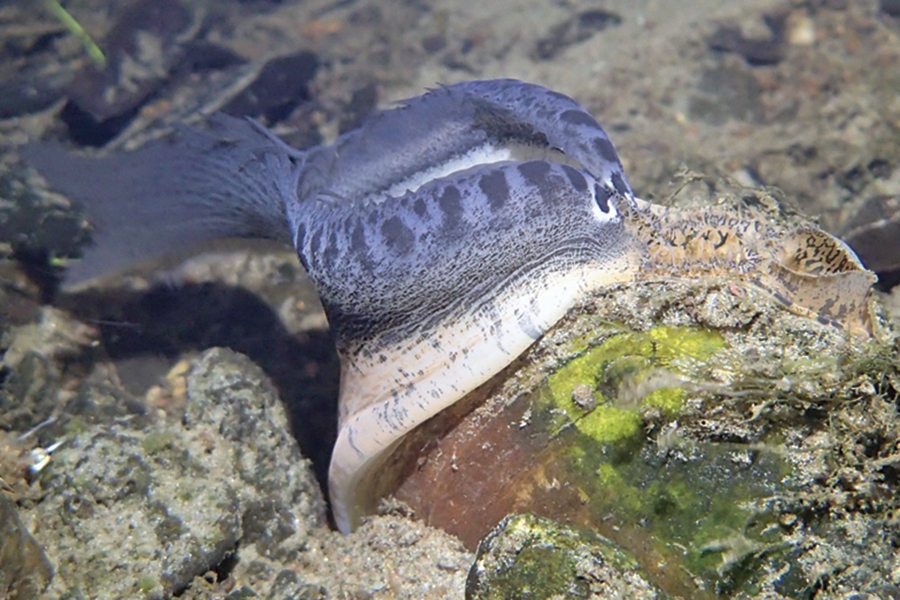
To increase the odds the glochidia can find their hosts, female mussels have evolved complex strategies to attract specific fish by mimicking prey items the fish would like to eat. When a fish tries to eat this “prey,” the female releases the glochidia.
Each larva attaches to the gills or fins of the fish, and a cyst forms around it. It remains for two or more weeks until the glochidium develops into a juvenile. At that point, the tiny mussels detach and settle along the streambed, leaving their hosts no worse for the wear. It’s likely not surprising, but because in part to this complex but necessary chain of events only two in 1 million glochidia live to produce glochidia of their own.
Freshwater mussels may be easy to miss on a paddle down the West Branch DuPage River, but there’s no overlooking the invaluable “ecosystem services” they offer to the greater aquatic environment, either directly or indirectly, by simply doing what they do.
An example of the simplest ecosystem service is the mussel’s shell. Alive or dead, a shell provides habitat for macroinvertebrates, crayfish, fish, algae, moss and other organisms.
The majority of freshwater mussels’ ecosystem services are a little more complex, but some result simply from how they eat.
Freshwater mussels are “filter feeders.” They draw food into their soft bodies by pulling in large amounts of water through an “incurrent siphon.” As they do so, they take in bacteria (even E. coli), algae and other organic matter that’s suspended in the water. One mussel can filter more than 6 gallons of water a day in this way, and large groups, or “beds,” of mussels can filter enough to decrease pollutants and increase water clarity across an entire waterway.
Mussels further decrease pollutants by storing elements such as nitrogen, phosphorous and carbon for decades in their soft bodies, lessening the negative effects these nutrient pollutants can have on the environment. (They’re an underwater biological treatment plant that doesn’t cost a thing!) When freshwater mussels deposit the remains of their different meals onto the sediment via an “excurrent siphon,” the mix of digested and undigested waste creates a source of food for other creatures, including other mussels.
Freshwater mussels provide additional ecosystem services when they burrow into the sediment. Each mussel has a large muscular foot, which it uses to move around and secure itself to the riverbed. As it burrows, it releases oxygen trapped between the fine particles and holds sediments together, keeping them from flowing downstream during heavy rains.

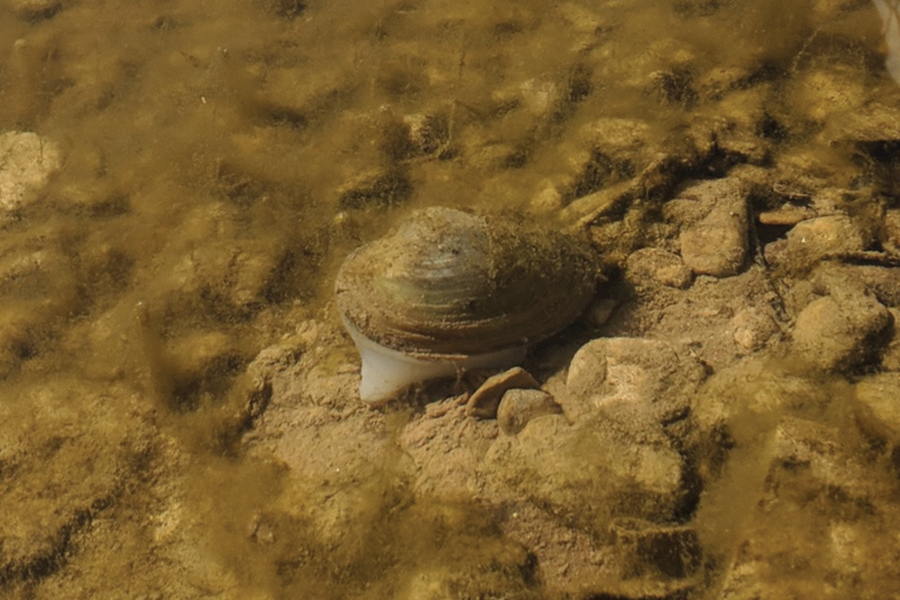
A freshwater mussel has a muscular foot (a white one is shown here), which it uses to move around or burrow into the streambed.
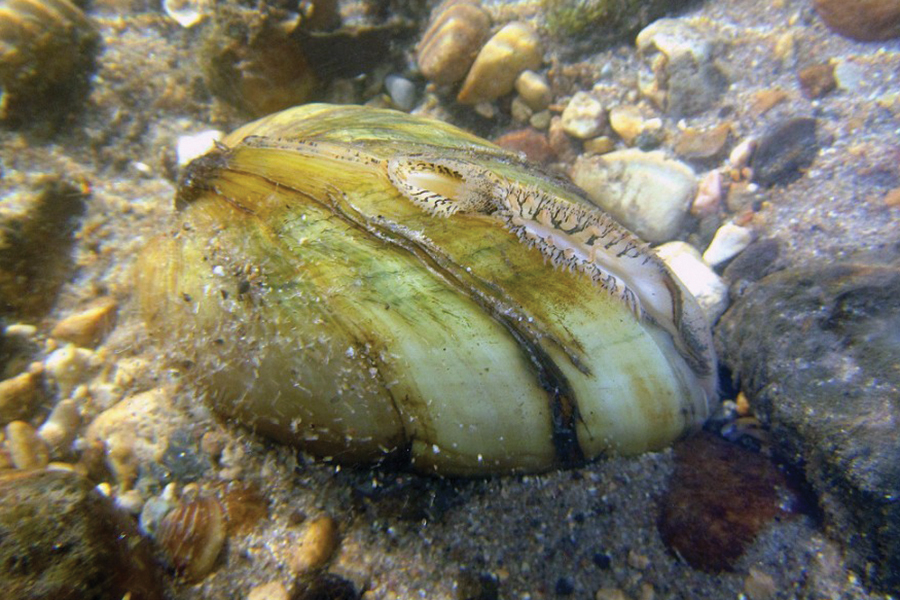
The opening on the right is the mussel’s “incurrent siphon,” which takes in water, oxygen and food. On the left is the “excurrent siphon” that releases waste.
Many female mussels have “lures” they display to attract fish. Mussel larvae need to latch on to certain fish to develop.
How to Identify Freshwater Mussels
To make sure they collect the right species, ecologists need to be able to reliably identify mussels in the field without guides or microscopes — a skill that also helps them get out of winter water as quickly as possible! The thing about mussels, though, is that some have distinguishing features while others are more difficult to label.
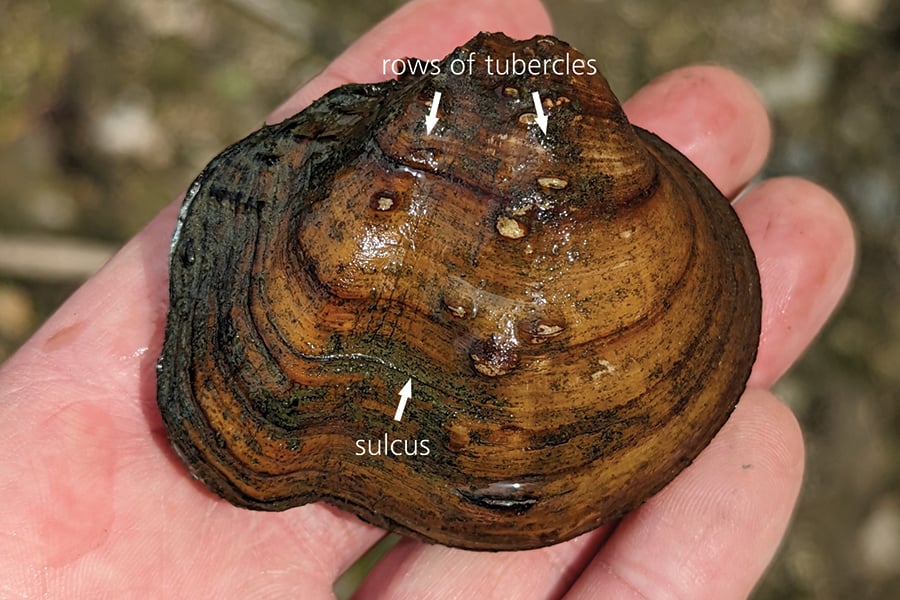
Of the 20 or so species ecologists work with on a regular basis (the District works with partner agencies to raise more than the nine that currently live in DuPage), the mapleleaf is one of the easier to ID. District ecologists first recorded the mapleleaf mussel in DuPage in 2023 as they were working in an unsurveyed stretch of the East Branch DuPage River. They quickly identified it by its distinct appearance, which includes a double row of raised knobs or bumps, called “tubercles,” separated by a shallow, elongated depression in the shell, known as a “sulcus.”
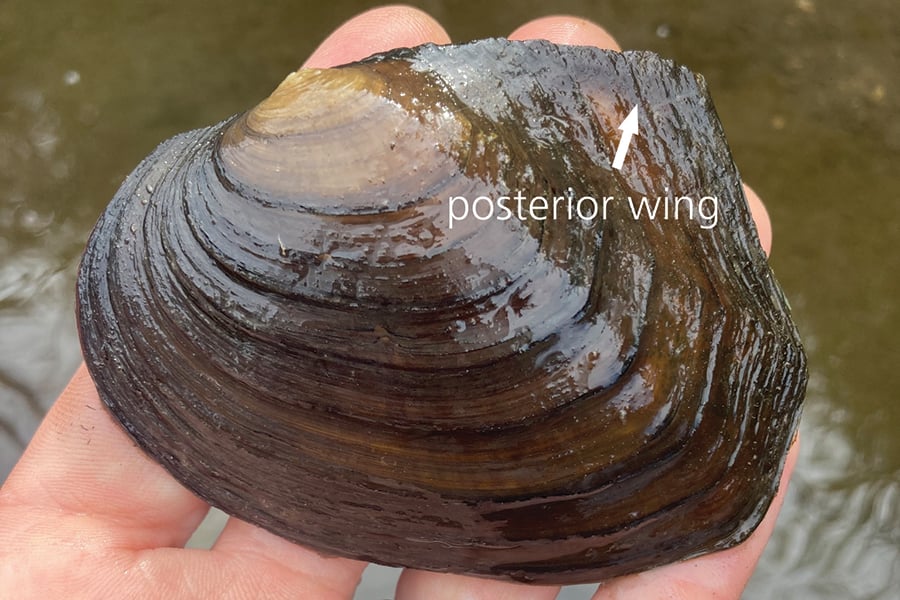
The mapleleaf was an exciting find, but more common species have equally striking appearances. One, the white heelsplitter, gets its common name from a part of its shell called “the posterior wing,” a flattened, often pointy extension at the back of the mussel’s body that can jut out of the riverbed as the mussel burrows. According to legend, the mussel earned its name when the scientist who first described it was walking barefoot through a stream and stepped on one, splitting his heel open. Since then, any mussel with a prominent posterior wing has been called a “heelsplitter.”
In wider northern Illinois, mussels have even more distinct features. One exemplary species (and one of my personal favorites) is the pistolgrip. This large mussel has a thick, elongated, laterally compressed shell with irregularly shaped raised bumps called “pustules” that cover about two-thirds of both halves of its shell. It’s one of the few freshwater mussels that’s sexually dimorphic, which means you can identify males and females just by looking at the shell. Males have shortened, squared-off shells. Female shells are longer and rounder so their gills have the space they need when they’re gravid. (Females carry developing larvae called “glochidia” in their gills before releasing them into the water. Ecologists can tell if a mussel is gravid by looking at its gills.)
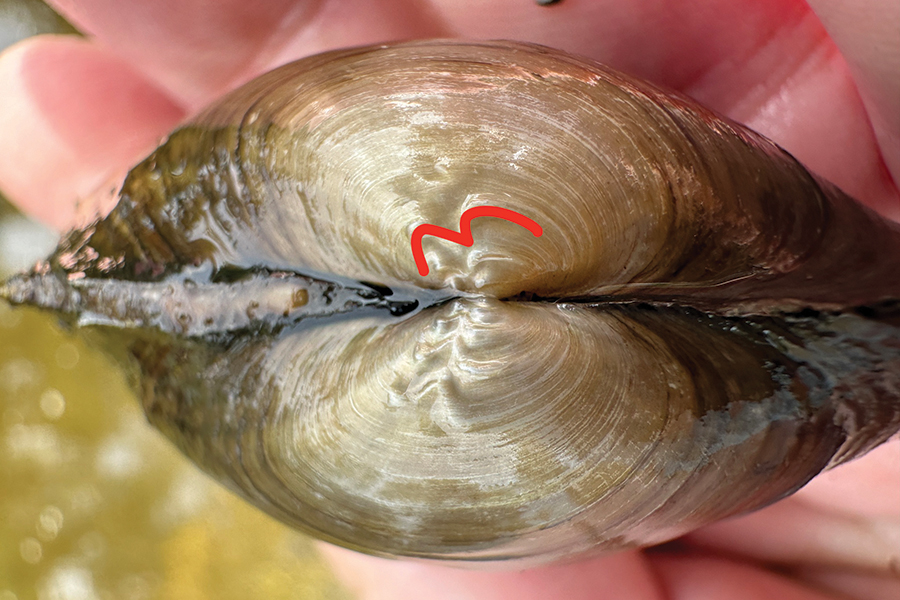
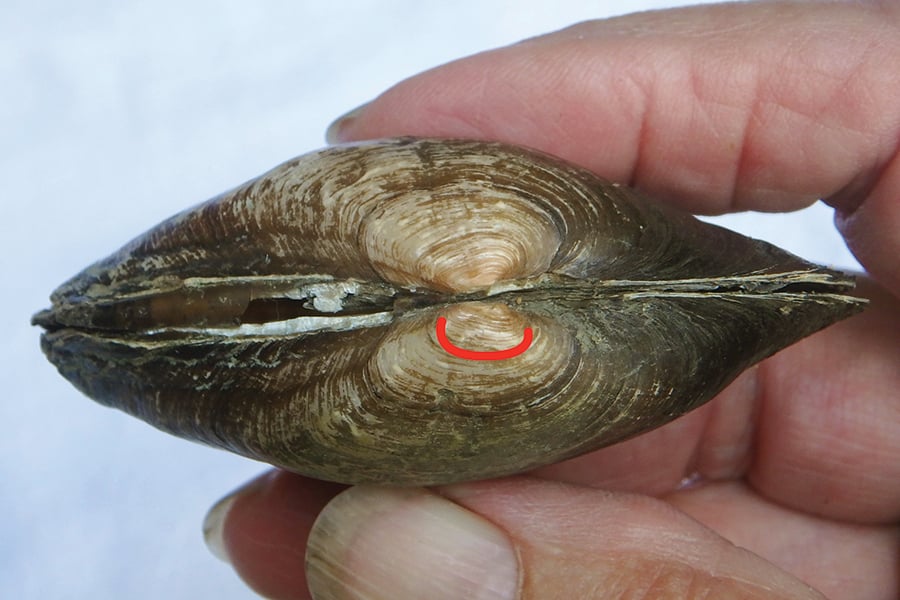
Although some mussels are easy to ID, others have just one or two minute discerning features. The giant floater and the creeper are prime examples. Even to the trained observer the two are nearly identical. Only tiny ridges on the “umbo” or “beak” of the shell, the hinge where the two parts of the shell meet, offer a clue. On a giant floater, these markings are called a “double-loop sculpture.” Picture a curvy M or a child’s drawing of a seagull. In comparison, the markings on the beak of a creeper are thickened, raised U-shaped lines.
A mapleleaf has two rows of bumps called “tubercles” separated by a shallow depression called a “sulcus.”
The white heelsplitter may have earned its name from its sharp posterior wing, which can be painful to step on.
Fully grown pistolgrip mussels can be up to 8 inches long.
Ecologists look at fine markings (overlaid above in red for emphasis) on the “beaks” of some mussels to help with identification. Those on a giant floater look like a curvy M.
Creeper mussels have U-shaped markings on their beaks.