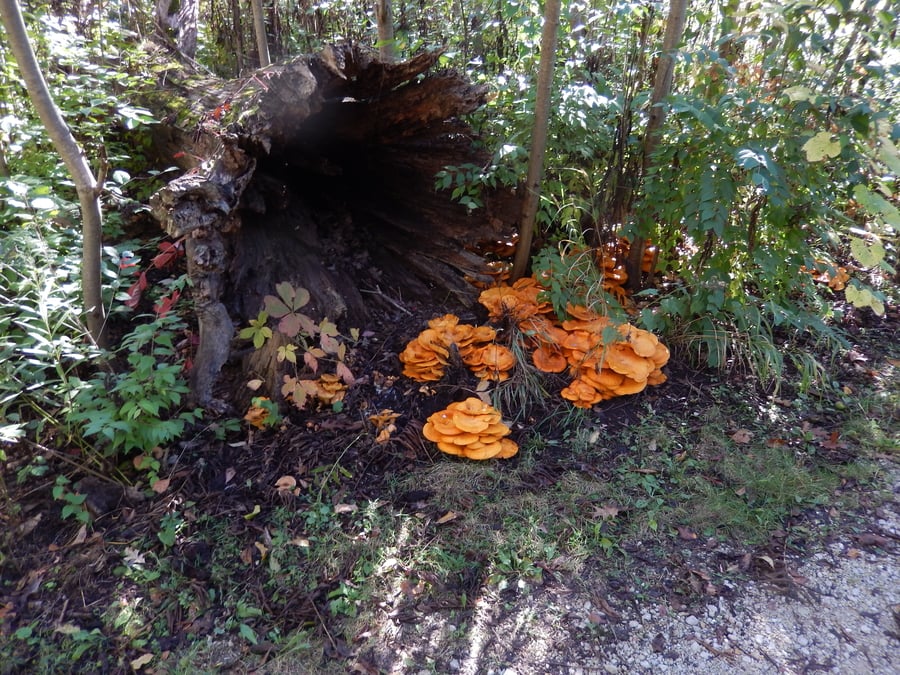
Fungi grow in many shapes, sizes, and colors. They can be found under logs, on trees, or pretty much right out in the open. Though ubiquitous, fungi are some of the least studied organisms in the environment.
However, volunteer Crystal McAllister continues to build an official database of fungus species present in DuPage County’s forest preserves, one sighting at a time.
“My goal is to educate the public and forest preserves about fungal diversity and increase species lists for specific forest preserves,” McAllister said.
In 2013 McAllister, a biology teacher at Proviso East High School, worked with staff to launch the District’s fungus monitoring program after she noticed how little data the District possessed. Back then, the District’s database included just 60 species of fungi.
With McAllister’s efforts, the District’s database expanded to include more than 3,000 observations that identify 356 different fungal species. McAllister and other volunteers recorded these sightings from 169 ecosystems in 31 forest preserves.
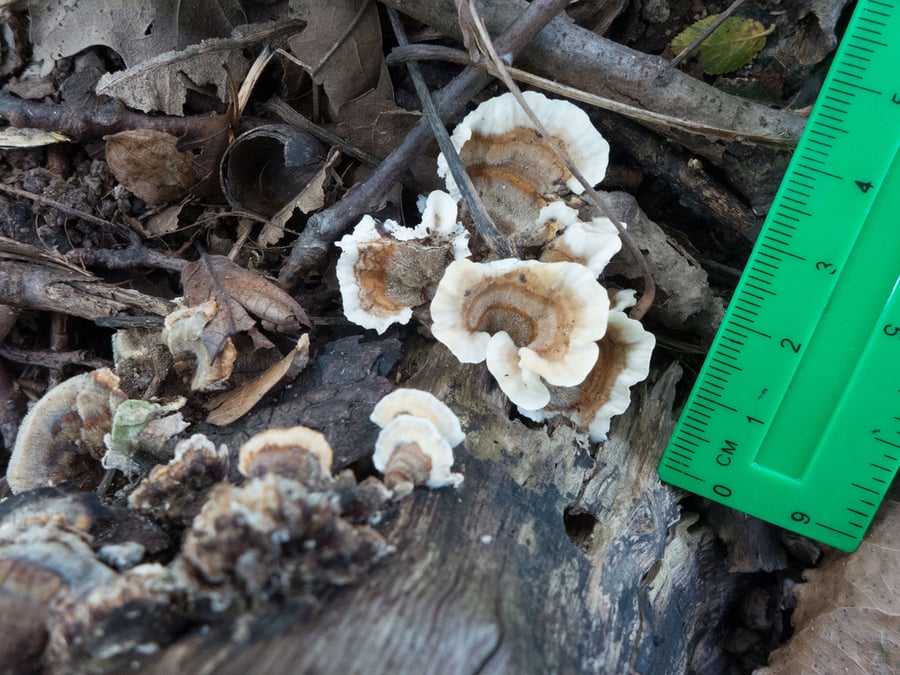
Volunteers use a ruler to measure and give scale to the fungi they document for the District's database.
McAllister has studied fungi on and off since the seventh grade, when she performed a science project on mold.
“I got really interested in anything that is plant and animal at the same time,” she said.
In college, a field mycology class increased her desire to learn more about these organisms, while also introducing her to the thrill of identification.
Growing up in the region, McAllister fell in love with the forest preserves near her house, so starting the program with the District felt natural.
Compared to Europe, the U.S. lacks information about local fungi, she said, adding that mushrooms have even gotten a bit of a bad rap because some people are afraid they’re poisonous or hallucinogenic. Mushrooms are the fruiting body of certain types of fungi.
“There are poisonous ones around, but most of them are doing what they need to, like decomposing wood,” McAllister said. “They’re really just part of the ecosystem.”
(It’s important to note that foraging for or collecting any natural resource, including fungi, without a permit is prohibited in DuPage forest preserves.)
McAllister runs the fungus monitoring program alongside Kathy Lech, the District’s stewardship technician, who oversees about half of the District’s monitoring programs. Residents who want to learn more about the program or who are interested in joining can attend the annual training workshop. After completing the volunteer onboarding process, qualified applicants receive a lighted magnifying glass, a ruler for size references, and an extendable mirror to assist in photographing fungi without disturbing them. Volunteers also receive instruction on data entry and GPS.
Volunteers work from about April to November, depending on weather conditions. They pick one or two forest preserves to monitor, generally a favorite or one near their home. It’s preferred volunteers make monthly monitoring visits, which usually take about an hour or two. They can stay on hiking paths or venture into the woods.
After collecting information in the field, volunteers upload photos and fill out forms in a Google Drive document, noting identifying information like size, shape, color, habitat, and location. Though volunteers don’t need a background in identification, some get invested in the process while others simply enjoy a relaxing stroll in the woods with a camera.
“It is kind of what you make of it,” Lech said. “Some volunteers really get into it, and it becomes a passion of theirs.”
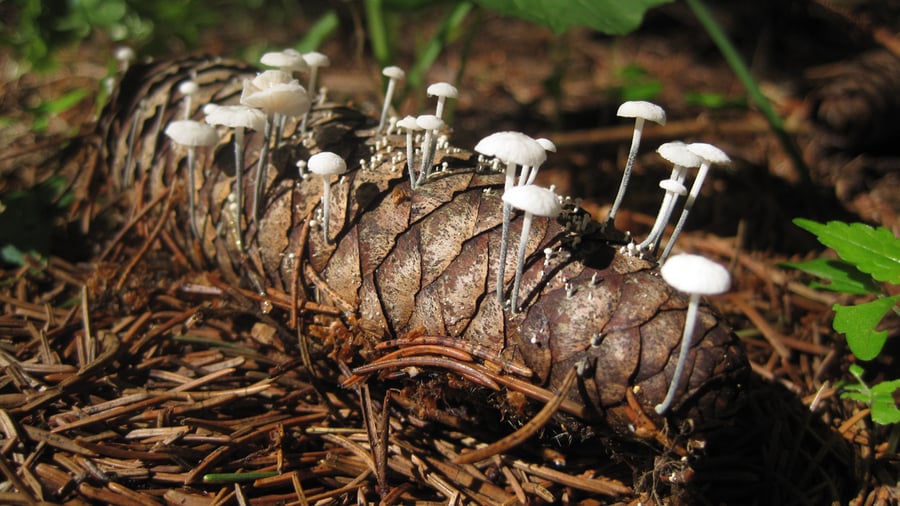
Searching for fungi allows participants to relax and connect with nature.
Along with performing her own surveys, McAllister leads a few excursions each year to provide more training, answer questions, and build relationships with the volunteers.
During her winter break from teaching, McAllister analyzes the collected data and identifies the observed fungi.
“It’s always cool to see a species that you haven’t seen before,” she said. “Every year a volunteer finds a species I’ve never seen before.”
When she’s finished with all the paperwork, McAllister submits her data to the District, which she hopes will help with conservation efforts.
“I think the gift to us is giving us the data so we know what’s out there,” said District President Dan Hebreard.
While leading the program is generally satisfying — like being called upon by the Field Museum to find and collect a sample of a new type of chanterelle mushroom — there are a few common difficulties. Data entry can overwhelm some volunteers, which the District could use more of. Eight volunteers submitted data in 2024, which is about average for the program. McAllister and Lech said having a roster of 20 volunteers would be ideal to monitor the necessary sites without creating a backlog of information.
Plus, McAllister said, “Spelling the fungus’s names can be difficult.”
She added eight new species to the District’s database in 2024, and she plans to continue the program for the foreseeable future to help the District understand the ecosystem their tasked with preserving.
“It’s kind of like the forgotten species that’s out there,” Lech said. “We’re glad that there are volunteers donating their time for this cause.”