
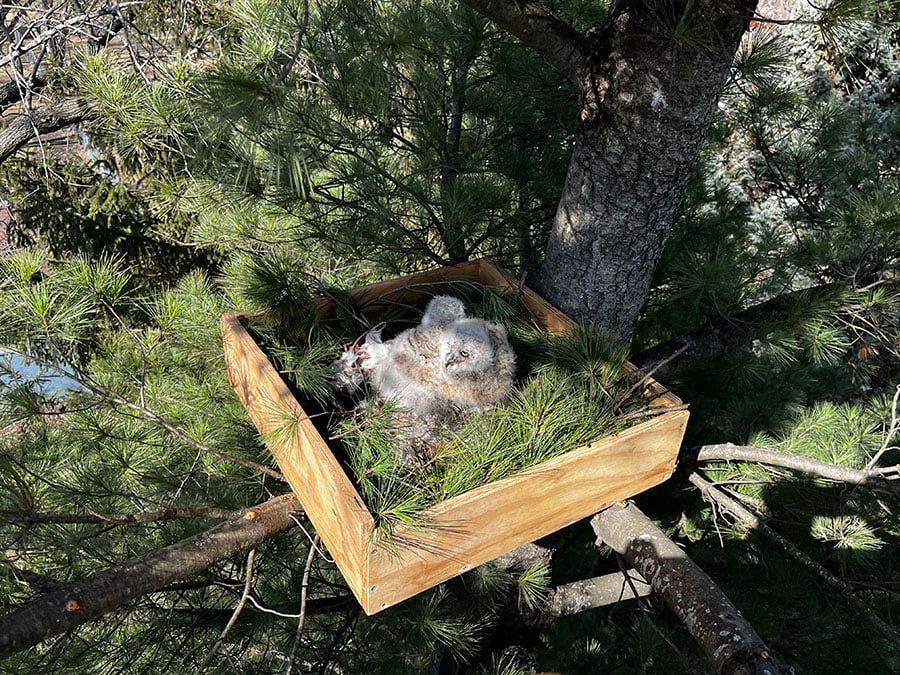
As the sun shined on a warm February morning, forestry worker Ken Ruhaak parted pine branches to secure an owl nesting box to the tree’s trunk and populate it with two baby owls.
Two days earlier Roselle residents found one of the babies under a white pine tree in their front yard. Following recommended best practices, the couple contacted DuPage County Animal Services. While waiting for county workers, the couple wrapped the owl in a towel and placed it in an old bird cage to keep it safe from potential predators.
Animal Services took the owlet to the Forest Preserve District’s DuPage Wildlife Conservation Center. There, employees assessed the animal, making sure it didn’t suffer any injuries from its roughly 30-foot fall.
Employees deemed the owlet healthy and its nest location suitable. The mature tree was easily accessible and a short flight away from Mallard Lake Forest Preserve, where the owl would have suitable habitat and feeding grounds. Equally important, the property owners said they saw adult owls almost daily.
On the warm, sunny morning, a team of District employees met at the Roselle residence. Ruhaak and fellow forestry worker Kale Nelson arrived in an aerial lift truck and parked on the street near the nest-holding tree. Donning an orange hard hat and sunglasses, Ruhaak strapped himself into the truck’s bucket and raised himself about two-thirds of the way up the tree to inspect the old nest.
“It was flat as a dinner plate,” he told Nelson and Stephanie Scurtu, an animal keeper from the DuPage Wildlife Conservation Center who drove to the site with the precious young cargo.
Great horned owl babies are notorious for stumbling out of their nests and falling to the ground, where they are helpless.
“A predator would likely come across it and pick it up,” Scurtu said. “They have zero chance of defending themselves.”
Great horned owls typically use old nests of other birds, which aren’t always the sturdiest. To help owlets who fall from poor nests, employees or volunteers construct owl nesting boxes. Made of plywood, the 2-by-2-foot boxes have 6-inch walls to help prevent babies from potentially fatal falls. Small holes drilled through the bottom assist with drainage and aeration.
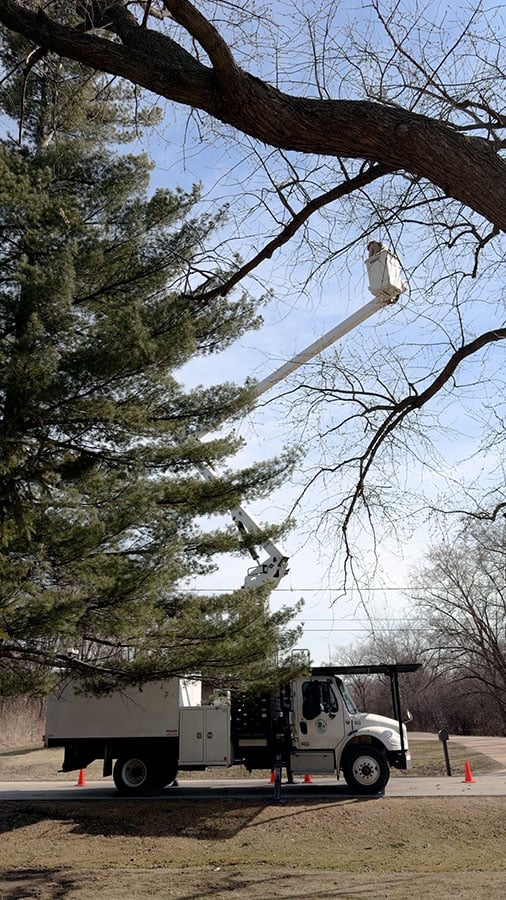
District foresters use an aerial lift truck to access the upper portions of a pine tree where they installed an owl nesting box.
While Ruhaak secured the box to the tree, Nelson clipped a bucket of pine needles to use as bedding. Ruhaak then placed the needles in the box along with the old nest.
Scurtu retrieved a white bucket from her van, which contained not only the fluffy grey baby that fell from the Roselle tree but a second great horned owl with deep yellow eyes of its own. This second owlet fell from a tree in Carol Stream days earlier. Unfortunately, its nest was in a poor area, and its parents couldn’t be located. District staff treat about 20 owls a year, Scurtu said.
Fortunately, owls, like geese, are one of few animals that will raise another’s offspring, so after making sure no other owls were in the nest, the workers placed both owlets in the new nesting box.
“Mom is the greatest caretaker,” Scurtu said. “If we can return a baby to the wild, we will take that option.”
If that wasn’t an option, staff would have raised the owlet until it was ready to survive on its own and released it in the fall.
After about an hour of work, staff had returned the two owlets to the wild and provided them with a shelter that will hopefully last for generations. Also in that box? A present for the mother owl, who now has two mouths to feed: a dozen mice.
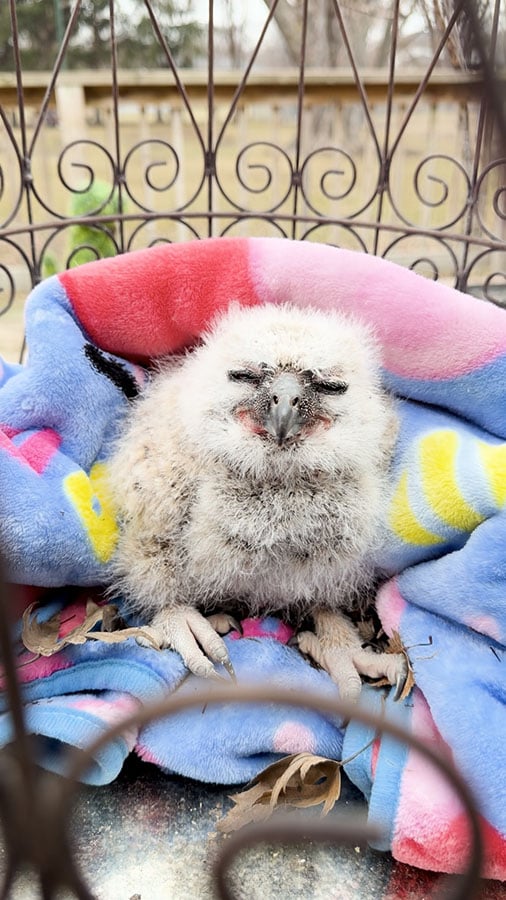
This owlet was rescued by homeowners after it fell from its nest in their front yard.