
Press Packet
Introduction
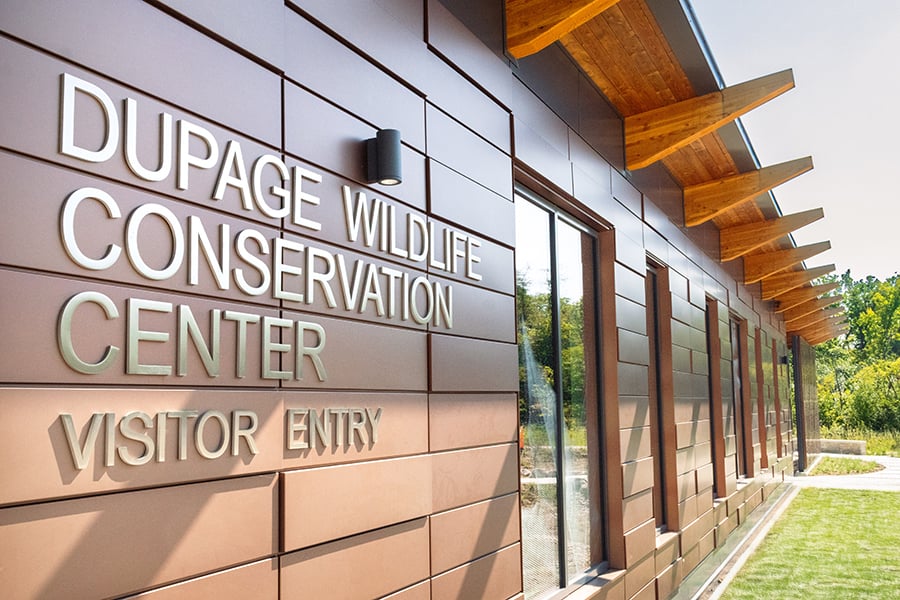
Located within the 48.25-acre Willowbrook Forest Preserve in Glen Ellyn, the new DuPage Wildlife Conservation Center is a 27,000-square-foot state-of-the-art wildlife rehabilitation clinic and visitor center and the Forest Preserve District’s first net-zero-designed building.
The center has indoor and outdoor treatment and rehabilitation areas, educational exhibits on wildlife rehabilitation, an outdoor classroom, an interpretive trail with observation areas, and outdoor activity spaces that demonstrate how to attract and live in harmony with native wildlife.
Media Contacts
Anamari Dorgan
Director of Community Engagement
630-462-5654
Beth Schirott
Communications Specialist
630-871-6401
Additional Content
When using any Forest Preserve District photo or video clip, use the following credit line: Courtesy Forest Preserve District of DuPage County.
FAQs
Background
The Forest Preserve District of DuPage County acquired the property in 1956. It was the first time an owner had donated property to the District. The original owners asked the District to retain the nickname “Willow Brook” and to keep the land as a bird sanctuary.
The previous clinic and visitor center were built in 1981 and opened as the Willowbrook Wildlife Haven.
In 1993 the District renamed the facility Willowbrook Wildlife Center.
Planning for the new center began in 2022, and in 2024 the District chose to name it the DuPage Wildlife Conservation Center at Willowbrook Forest Preserve to highlight a renewed emphasis on conservation and the range of wildlife-related activities conducted at the center, including rehabilitation, the propagation of endangered and threatened species, and efforts to educate visitors about ways to peaceful coexist with our animal neighbors.
The visitor center opened to the public on Jan. 12, 2026.
Project FAQs are at dupageforest.org/what-we-do/projects/willowbrook-master-plan.
What are the center's hours?
The visitor center and animal admittance area are open 9 a.m. to 4 p.m. Thursday through Tuesday and 9 a.m. to noon on Wednesdays. The center accepts most wildlife patients, but people should call 630-942-6200 in advance. Online rescue advice is at dupageforest.org/places-to-go/centers/wildlife-conservation.
The surrounding Willowbrook Forest Preserve is open daily from one hour after sunrise to one hour after sunset.
Is there a fee to enter?
There is a suggested general admission donation of $5 per person for ages 3 and up.
What is a net-zero-designed building?
Net-zero buildings produce as much energy as they consume to reduce greenhouse gas emissions. This building was constructed using sustainable materials and alternative energy sources to reduce its carbon footprint. The monitor in the net-zero nook in the visitor center explains more.
What can people see through the windows inside?
The center's goal is to improve the overall quality of care of its wildlife patients while highlighting the rehabilitation process and teaching visitors about local wild animals. As such, from time to time, visitors may see animals as they're being treated through the clinic, surgery, and rehab windows. Activities will vary seasonally.
Why are animals not always in the windows?
Wildlife rehabilitation coincides with natural patterns, life cycles, and seasons. Most species breed in spring and fall, which is when visitors will see the most activity.
During colder months, most animals migrate to milder climates. Those that stay may have more dormant lifestyles. We continue to take in animals that remain in the area and require care during that time, but we have far fewer patients.
Why are the curtains sometimes closed?
The Forest Preserve District has a migratory bird rehabilitation permit from the U.S. Fish and Wildlife Service that allows it to treat federally protected birds, which make up the majority of species that live in or pass through this area.
The permit requires, though, that the birds not see or hear visitors while they're being treated. If a curtain is closed, clinic staff are likely treating a protected species, but they may also close it if they're dealing with a sensitive matter and require privacy.
Why are there dots on the windows?
The dots make it easier for birds to see the windows, which lowers the risk of a collision if a bird takes flight. All of the exterior and interior windows at the DuPage Wildlife Conservation Center are designed to be bird-friendly.
Each year the center treats thousands of migratory birds from the Chicago area that suffer trauma or injury from window collisions. It is estimated that these collisions kill over a billion birds in the U.S. annually. Visitors can discover ways to prevent window collisions at home on the “Common Threats” display inside the visitor center.
Where are the animals that used to be in the visitor center and on the exhibit trail?
These animals are now in behind-the-scenes retirement housing that provides the accommodations these geriatric and disabled animals need to live comfortably and with less stress. Visitors may occasionally see the animals, though, on the monitors in the visitor center.
The animals have indoor-outdoor enclosures that allow them to choose where they spend their time. In extreme winter weather the indoor enclosures are closed and heated.
We've noticed improvements in their welfare living off-exhibit, including:
- Increase in natural behaviors such as singing or vocalizing, preening, nesting or breeding, engaging with enrichment, and participating with trainers
- Improvement in feathers
- Decrease in fear, escape, and avoidance behaviors such as flying away, falling to the ground, pacing, hiding, vomiting, or only being active after-hours
It takes a lot of resources to correctly rehabilitate wild animals and keep them in managed care, so moving forward the center will not house additional residents. The current enclosures will eventually transition into rehab housing when they are no longer needed. Animals that cannot return to the wild will be placed at other facilities whenever possible.
What can people do at the DuPage Wildlife Conservation Center?
There are several ways people can experience the site.
- Explore the displays inside the visitor center.
- Borrow a pair of binoculars from the visitor center.
- Borrow a backpack from the visitor center. The all-ages "Wildlife" backpack gives you ways to find signs of wildlife — and sometimes the animals, too! "Exploring Ecosystems" features tools the scientists use that let you collect data from two different ecosystems so you can learn how nonliving parts of an ecosystem interact with the living. It's recommended for ages 8 and up, but the tools should always be used with adult assistance. Both backpacks are available in Spanish.
- Go on a scavenger hunt using Goosechase. Download the Goosechase app, search for “DuPage Forest,” and choose a hunt to begin.
- Explore the nature trails behind the center. Woodchuck Way leads over a bridge to the 1-mile Coyote Loop, which has six interpretive nodes featuring restored ecosystems.
- Register for a nature program. Upcoming programs are listed near the bottom of the page at dupageforest.org/places-to-go/centers/wildlife-conservation.
- Watch staff and volunteers feed baby wildlife through the last two windows inside the visitor center at 10:30 a.m. and 1:30 p.m. roughly between April and September.
Who painted the mural?
Artist Joel Sheesley of Wheaton, Illinois, painted the mural, which is entitled The Release. Sheesley’s works address the local northeastern Illinois landscape, and he has collaborated with several agencies engaged in conservation and habitat restoration. Sheesley is a professor emeritus at Wheaton College, where he taught painting for 42 years.
Who were Dr. Douglas and Frances Mains?
Douglas and Frances Mains were lifetime DuPage County residents recognized for their work as conservationists and philanthropists. They made a significant contribution designated for use at the center. Douglas Mains was an orthopedic surgeon who pioneered hip replacement surgery in DuPage County in 1967. He has been credited with starting the Friends of Danada.
Who helped support the construction of the new center?
This project was made possible in part thanks to the following agencies:
Illinois Clean Energy Community Foundation
Illinois Department of Natural Resources Open Space Land Acquisition and Development Grant
Illinois Department of Natural Resources Endangered and Threatened Species Rehabilitation Grant
Institute of Museum and Library Services Museums for America Grant
U.S. Department of Energy’s Office of Energy Efficiency and Renewable Energy
Friends of the Forest Preserve District of DuPage County