Conservationist Spring 2026
From the President

Back when I was a Forest Preserve District of DuPage County ranger, spring was an encouraging time of year. Not only were trees budding, early spring wildflowers blooming, and birds returning, but the trails were coming alive with more and more visitors emerging from their own winter hibernations. It meant that I would again have the opportunity to welcome back many forest preserve fans and talk with them about the awakening landscape and the wildlife that call it home.
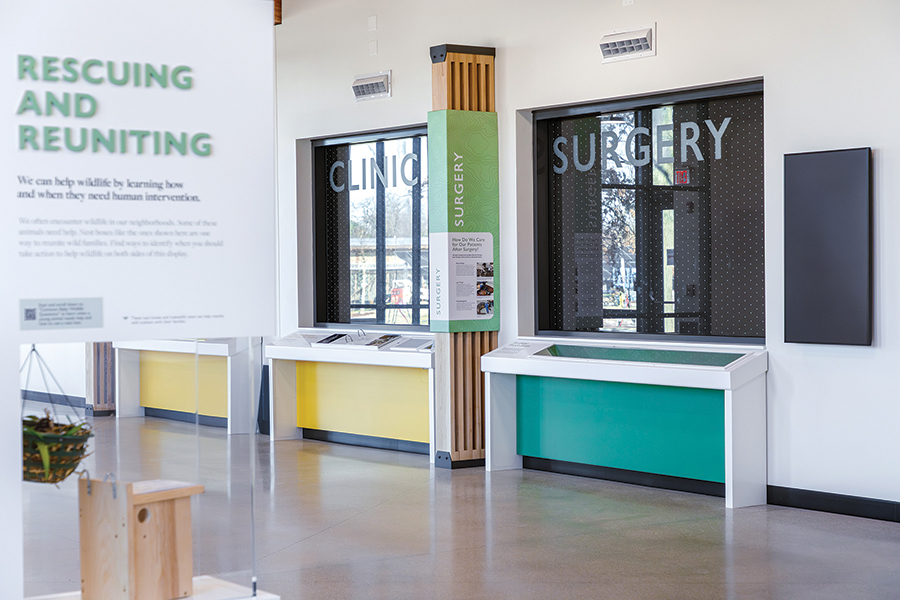
This spring, the Forest Preserve District is also welcoming wildlife lovers to the visitor center at the DuPage Wildlife Conservation Center at Willowbrook Forest Preserve. This state-of-the-art wildlife hospital (and the District’s first net-zero-designed building) offers behind-the-scenes peeks at the wildlife rehabilitation process and exhibits on native wild animals that show how we can do our part to help and protect them. The timing is ideal as baby animal season (and the center’s influx of calls from concerned residents) is about to begin. You can read about the young birds and mammals you find in your own backyard and when the center’s help might be needed in “If You Care, Leave It There,” which you can read below.
I also remember as a ranger talking with people about the subject of some of their not-so-favorite animal encounters: snakes. But as you’ll read below in “How About a Little Respect?” these sometimes-underappreciated reptiles play invaluable roles.
Of course spring also means our annual native plant sale, guided hikes, fishing and kayaking adventures, and so much more, so check out the calendar to find your next excursion. I just might see you there!
Daniel Hebreard
President, Forest Preserve District of DuPage County
News & Notes
Collections Corner
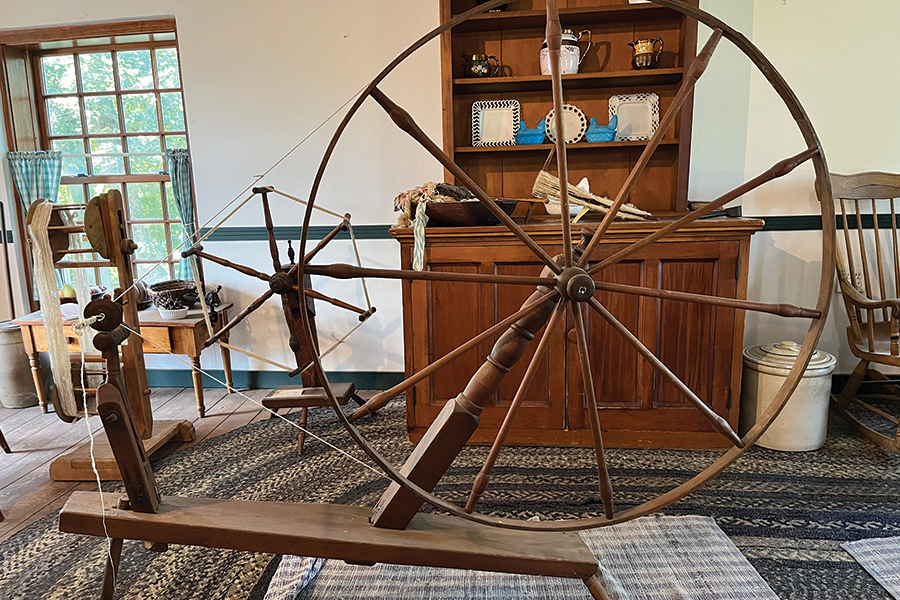
Turning raw materials like wool, flax, or cotton fibers into yarn is an arduous task. First you need to “draft” (pull or stretch) the fibers to separate and thin them. You then need to twist them into a tight straight line, making a thread. Fortunately, spinning wheels can make the process quicker and easier.
It’s unclear when the first spinning wheel was made, although it was likely in Asia or the Middle East thousands of years ago. A “great wheel,” such as the one shown, is one of many forms a spinning wheel can take. The large wheel connects to a spindle via a cord. The person spinning pushes the wheel with one hand while using the other hand to draft the fibers. This type of wheel is also called a “walking wheel” due to the way the fibers are drafted and how yarn is deposited on the wheel. By holding the fiber at different angles as the spindle turns, a spinner can alternate between drafting and twisting the fibers and wrapping finished yarn onto the spindle. Often this means a spinner is shuffling forward and backward at the side of the wheel, almost like a dance.
Spinning wheels fell out of favor around the Industrial Revolution, when mechanized inventions greatly outpaced them, but you can see this great wheel in action at the Graue Mill and Museum, which opens for the season mid-April.
Mayslake Hall 2026 Closure
Mayslake Hall at Mayslake Peabody Estate is closed as the Forest Preserve District works to renovate the interior of the 100-year-old building. The extensive project will upgrade mechanical systems to meet code, add or replace plumbing so there’s access to water for cleaning purposes on all levels, remove the unused south section of the retreat wing, and upgrade the storage area that houses the District’s collection of historic and natural history artifacts.
The surrounding forest preserve and access to Trinity and Mays lakes will remain open. For updates visit the Mayslake Peabody Estate webpage.
DuPage Wildlife Visitor Center
The visitor center at the DuPage Wildlife Conservation Center at Willowbrook Forest Preserve is welcoming guests with behind-the-scenes looks at the science of wildlife rehabilitation and exhibits on native wild animals and how residents can coexist with them in their own backyards.
The visitor center and the animal admittance area are open Wednesdays 9 a.m. – noon and Thursday – Tuesday 9 a.m. – 4 p.m. They’re closed on Thanksgiving, the day after Thanksgiving, Christmas Eve, Christmas Day, and New Year’s Day. The center accepts most wildlife patients, but please call 630-942-6200 before arriving.
Upcoming programs at the center are online on the center's webpage.
Celebrating Our Awesome Volunteers!
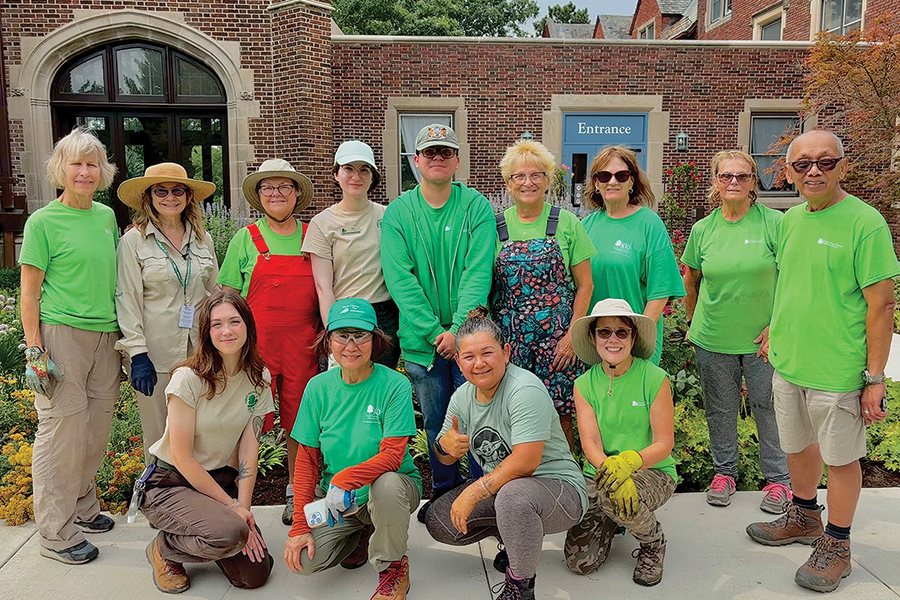
In recognition of National Volunteer Week, April 19 – 25, the Forest Preserve District applauds its 786 long-term volunteers, 1,514 one-time volunteers, and 93 volunteer groups, who combined donated a total of more than 66,600 hours with an in-kind value of nearly $2.3 million in 2025.
With a variety of one-time, seasonal, and yearlong opportunities across 12 programs, the District is sure to have something to fit your schedule, pique your interest, and ignite your passion. For details visit our volunteer webpage, or contact us at 630-933-7233 or volunteer@dupageforest.org.
Thank You for Being a Friend
The Friends of the Forest Preserve District of DuPage County gratefully acknowledges those who donated $500 or more during the fourth quarter 2025 (or reached $500 cumulative annual giving in that same quarter). The Friends advances the Forest Preserve District’s vision through philanthropic endeavors and fundraising to benefit habitat restoration, wildlife preservation, and education and recreation programs.

Learn more or donate on the Friends webpage, or mail your gift to the Friends of the Forest Preserve District of DuPage County, 3S580 Naperville Road, Wheaton IL 60189. To discuss your giving plans or learn about Friends’ board service opportunities, please contact Partnership & Philanthropy at 630-871-6400 or fundraising@dupageforest.org.
Gift of $50,000 or More
Charles Johnson Estate
International
Gift of $10,000 – $49,999
CNH Industrial foundation
G. Carl Ball Family Foundation
Larry C. Larson
Carol O'Neal
Gift of $5,000 – $9,999
Roman and Molly Boed
ComEd, an Exelon Co.
Mary J. Demmon Private Foundation
Susan McLean
Dan Soline
Michael and Diane Webb
Gift of $2,500 – $4,999
Mary and Harold E. Bamford III
Joel Herning
Elaine Novak Jans
Republic Bank of Chicago
David and Eileen Stang
Ghislaine Stuart
Mary Upton
Thomas R. Williams and Kelly A. Quinn
Jody and Jerry Zamirowski
Gift of $1,000 – $2,499
The Alben F. and Clara G. Bates Foundation
Avani and Sunil Arora
Lois Barnett
Seth Becker and Helen Nam
James and Valerie Carroll
Rosemary and Robert Carroll
Jeff and Bonnie Gahris
Corryn and Nick Greenwood
Judith Grey
Mary Lotz
Mary Ann Mahoney
Guy and Sharon Matthew
Tricia May
Francis Mosillo
Lorraine Pachankis
Susan A. Page
David Raske
Hans and Susan Reiker
Diane Telander
Steven and Gayle Tyriver
Ellen Alekno Wier
Gift of $500 – $999
Charles and Ann Achilles
Barbara Basso
Toni Bazon-Forsberg
Jeffrey and Melinda Born Chapman
Chicago Ornithological Society
Susan and John Christensen
Howard Goldstein and Peggy McGrath
Lawrence Harding
H. Susan Jones Charitable Fund of DuPage Foundation
Kirti Kamboj
Ryan and Jeannine Kannegiesser
Bruce Kulik
Rebecca McDade
Kay McNab
Belinda Morgan
Annette Musil
Kerry Perry
Tiffany Ruddle
Marlen V. Schuett
Maria and John Shalanko
The Shebik Family
Ann Storm
Joseph and Daphne Suchecki
Steven Szafranski
John and Marion Tableriou
Craig and Margaret Votava
Susan Wachowski
Lisa and Hans Weckerle
Nancy Wirtz
Douglas Zimmer
Unlike humans, young wild animals spend large amounts of time without parental supervision.
If You Care, Leave It There
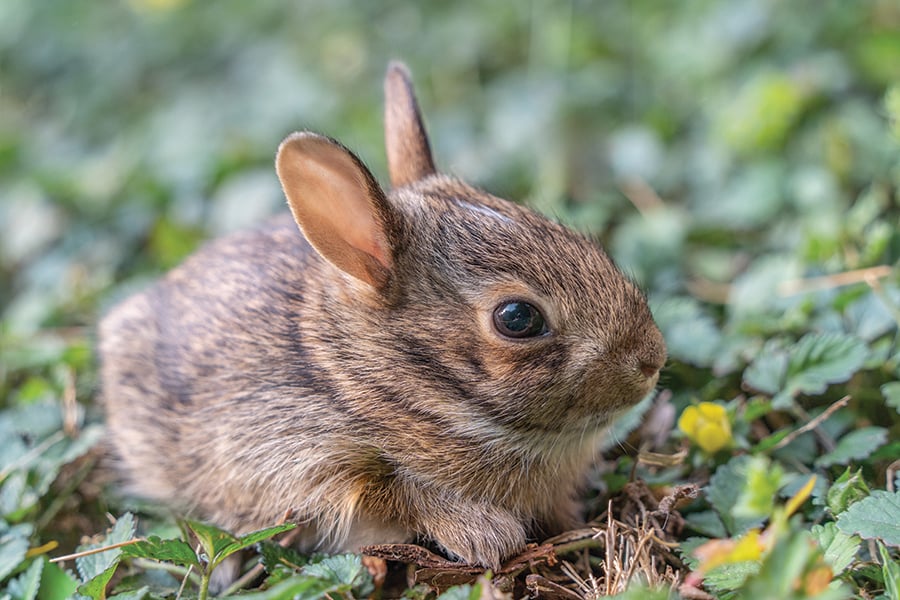
We’ve all come across one. That tiny ridiculously cute stray baby bunny wiggling its nose as it rests in the grass in the backyard. And we’ve all thought it. “That poor thing! All alone and abandoned by its mom!” And we were all most likely wrong.
This time of year the Forest Preserve District’s DuPage Wildlife Conservation Center at Willowbrook Forest Preserve gets hundreds of calls from people reporting baby wild animals seemingly orphaned by their parents. But in most cases, the animals are just doing what wild animals do. Young wild animals are not like humans. They’re not constantly watched by their parents. They spend large amounts of time alone or with their siblings.
In the case of those cute little eastern cottontails, if you find one hopping around with ears up and eyes open, believe it or not it’s old enough to be on its own. Cottontails stay with their moms only a few short weeks.
If it doesn’t look that physically developed, don’t immediately grab a shoebox with the intent to rescue. Look for the nest. It’ll likely be a shallow depression lined with fur and grass clippings (not a burrow as many may think). Gently place the bunny back in the nest and cover it with grass. It’s okay to handle a cottontail with gloved hands; the mother will not reject it. If the nest is in an area frequented by your dog, flip over a laundry basket, place it over the nest, and weigh it down with a rock. Remove the basket every night, though, so the mother can reach her babies. But don’t be surprised if you never see her. She only visits once or twice a night.
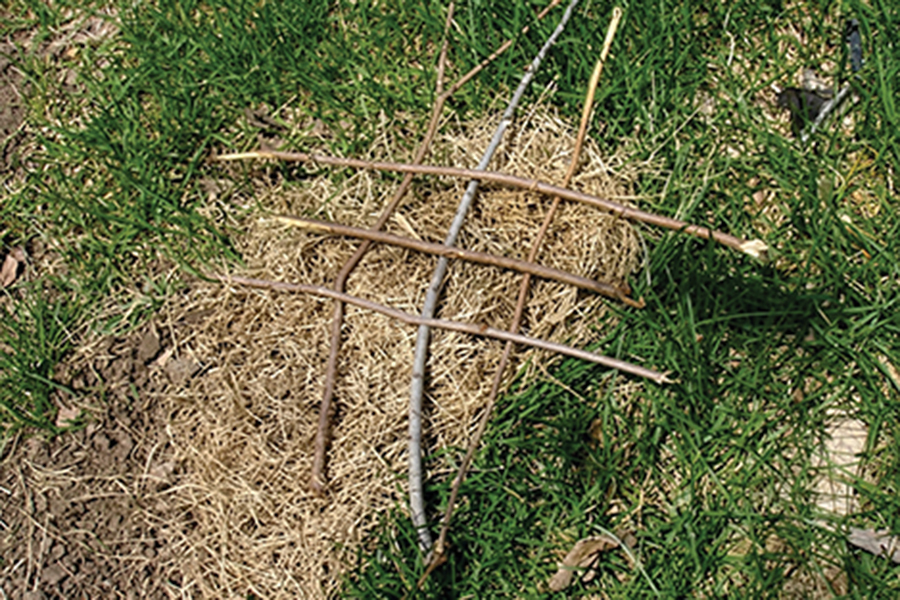
If you’re still concerned, you can check to see if the mother returns by placing twigs over the nest in a crisscross pattern. If they’ve moved overnight, the mom has likely been there, especially if the babies are warm and active with round bellies. If they’re cold and lethargic with flat bellies, they may truly be orphans, which means it’s time to give the DuPage Wildlife Conservation Center a call.
For birds, if you find a featherless downy or incompletely feathered chick, find the nest, and place the bird inside. Again, the parents won’t reject it because you’ve touched it. The wildlife center’s webpage shows how to create a makeshift nest if the original was destroyed or is out of reach. It also advises what to do if the parents don’t return.
If the bird is on the ground, has most of its feathers, and looks healthy but is unable to fly, leave it alone. It’s a fledgling, an older bird that can’t fly but can perch and hop, and its parents are likely nearby. Fledglings can live on the ground for up to two weeks while they learn to fly. During that time their parents will feed them and teach them how to protect themselves against predators. The adults may even swoop by or squawk at people or animals that get too close to their young.
Crisscrossing sticks over an eastern cottontail nest can show if the mother returns overnight.
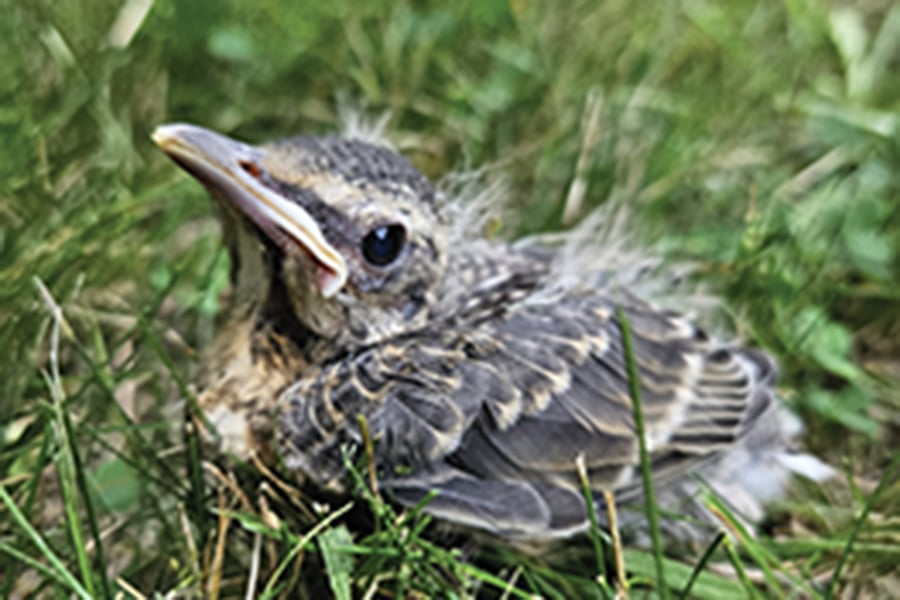
Fully feathered “fledglings,” like this American robin, can spend up to two weeks on the ground as they learn to fly.
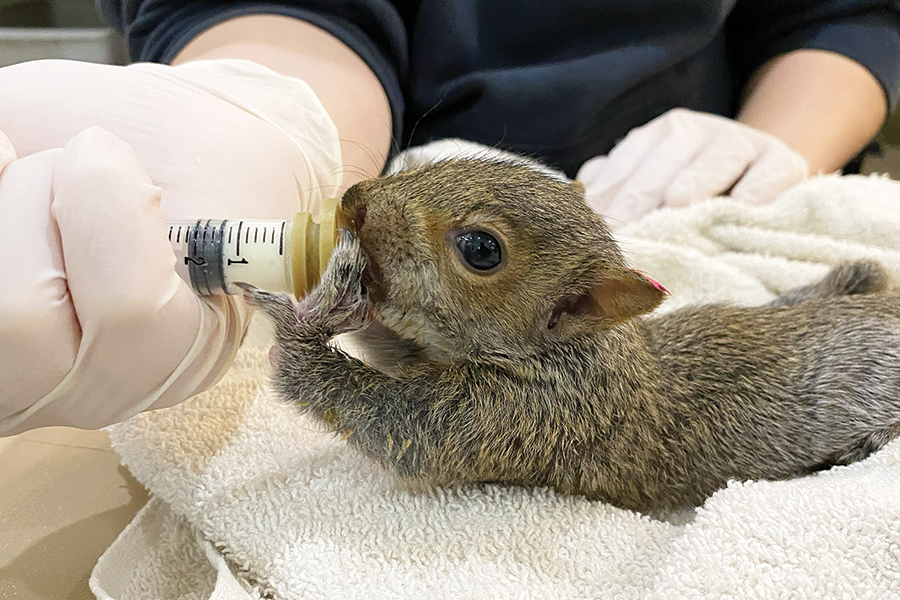
For tree squirrels, just one storm can destroy a large leafy nest, leaving babies stranded on the ground. If this happens (or the nest is there but you can’t reach it), place the young in a box near the tree or on a branch. You can borrow a wooden box from the DuPage Wildlife Conservation Center or make one of your own. Details are on the center’s webpage as are instructions on what to do if the mom doesn’t come back.
Virginia opossums — North America’s only marsupials — are an exception to the idea of “leave it there.” Young are born the size of honeybees in an undeveloped embryonic form. To survive, they must make their way in their first few minutes to their mother’s pouch, where they’ll nurse for about 80 days. If a baby falls out of the pouch, its mom will not be looking for it, so it will need the wildlife center’s help.
The wildlife center will take in baby tree squirrels when efforts to place them in nest boxes fail.
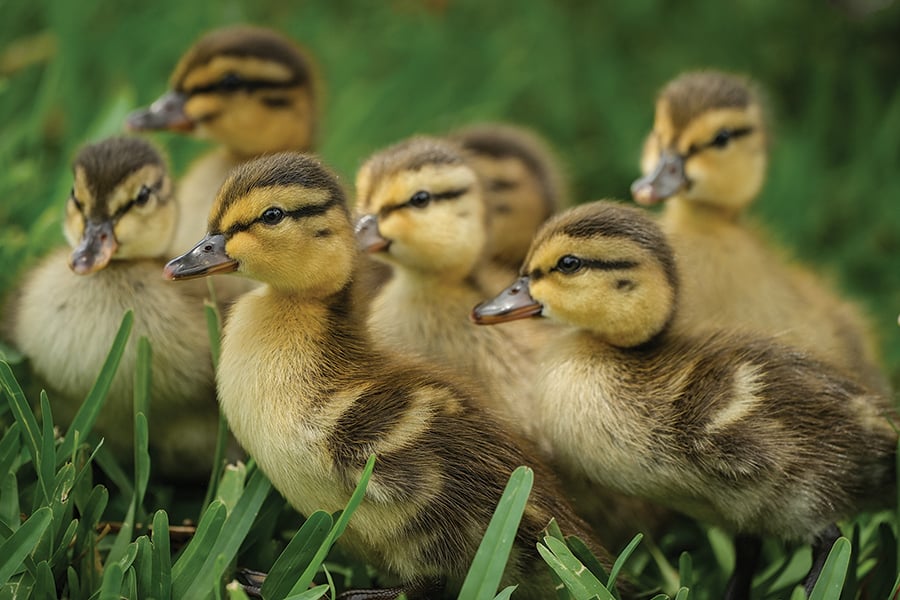
Ducks, geese, and opossums are exceptions to “leave it there.” These babies are constantly with their moms. If they’re alone, their moms aren’t coming back.

Of course there may be times when medical care is needed. If you see bleeding, signs of a fracture, a severe head tilt, swollen and crusty red eyes, maggots, or parasites, call the DuPage Wildlife Conservation Center.
Regardless of the situation, never take matters into your own hands and care for wildlife at home, even for a short time. It’s not only illegal but also harmful. These animals have specialized nutritional, housing, and handling needs only licensed facilities can provide. Babies in particular are high maintenance because they require multiple feedings a day. Inexperienced individuals who attempt to raise or treat them inevitably create unhealthy, tame animals that can no longer survive in the wild where they belong.
Although the DuPage Wildlife Conservation Center can successfully raise young native wildlife, in most cases animals fare better when you leave them there — in their parents’ instinctive care.
Phone First
The Forest Preserve District’s DuPage Wildlife Conservation Center in Glen Ellyn is open Wednesdays 9 a.m. – noon and Thursday – Tuesday 9 a.m. – 4 p.m. It provides care and medical treatment to most injured, orphaned, and sick native wild animals, but always call 630-942-6200 before you drive over. The animal may not need the center’s help. Additionally, the center can only care for so many animals at a time and may seasonally set capacity limits.
If the center isn’t open when you call, you can find detailed information online 24/7 on the center's webpage.
How About a Little Respect?
In the world of wildlife, snakes are some of the most misunderstood and underappreciated creatures, feared, loathed, and persecuted by many. With a little understanding, though, we can learn why we should respect snakes and all they do.
DuPage County is home to 13 types of snakes, the most prevalent being the common garter, eastern fox, midland brown, and northern water snake. Like alligators, turtles, and lizards, snakes are reptiles, which means they’re “ectothermic,” or cold-blooded. Instead of producing heat from what they eat, they draw it from the environment to elevate their body temperatures and increase metabolism. Snakes often do this by basking in the sun. When it gets too hot, though, snakes need to find shade or only emerge at night. Like other ectotherms they can’t pant or sweat to cool themselves, and abnormally high body temperatures can be lethal.
Also like other ectotherms, snakes have efficient metabolic systems. Their calories go much further than they do in warm-blooded animals such as mammals and birds, which continually burn calories to maintain internal body temperatures. These animals may use 90% or more of their calories to maintain temperature, but snakes can survive and grow using only 10% of that amount. Of course, the drawback is when things get cold, metabolism slows as does mobility, making snakes more vulnerable to predators.
To survive long-term cold temperatures, snakes enter a state of dormancy called “brumation.” It’s similar to hibernation but with a few subtle differences. To conserve energy, their metabolism, heart rate, and respiration slow, and their body temperature drop significantly. They enter a deep prolonged semiconscious slumber but will move around to drink water and bask if conditions allow. In preparation for this phase they seek out brumation chambers called “hibernaculums,” dark areas that typically have stable temperatures and moist air, which is critical to preventing dehydration. Larger chambers can house hundreds to thousands of snakes, even snakes from different species. You can read more about animals that brumate at in the 2023 winter Conservationist.
When brumation ends in spring, breeding begins and can continue throughout the warmer months. Female snakes can store sperm for a few years and still produce young it if they don’t encounter a mate.
Some snakes, such as the eastern fox, milk, smooth green, and North American racer, are “oviparous,” which means they lay leathery eggs. Others, such as the common garter, brown, red-bellied, Kirtland’s, queen, and northern water snake, are “ovoviviparous” or “live-bearing.” Live-bearing is a deceptive term, though, that describes something different than the way mammals give birth. The young snakes develop inside the female but do so in thin membranes, where they’re nourished via a yolk. There’s no placenta or direct connection with the mother. But no matter how they develop, once young snakes are born, they live independently without any parental care.
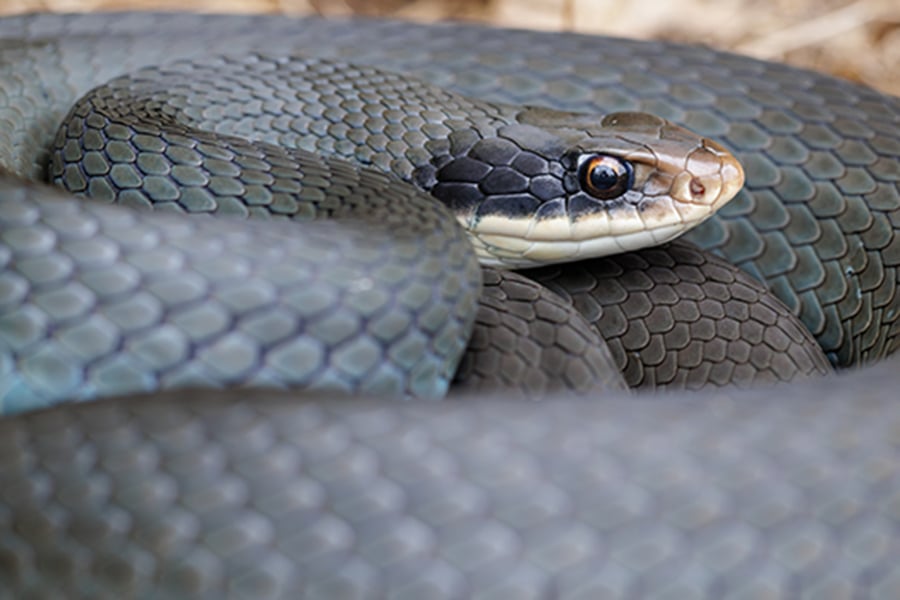
A snake’s body is covered in scales, either smooth or keeled. Both help reduce moisture loss, and both have their advantages. Smooth scales reduce drag and allow snakes to move more quickly, especially in dense vegetation. Smooth green snakes and North American racers both have these types of scales. Keeled scales have ridges that improve traction when climbing. Their texture also reduces light reflection, which helps conceal the snake. Queen, northern water, common garter, brown, red-bellied, Kirtland’s, and eastern fox snakes all have keeled scales.
Blue racers (shown here) and smooth green snakes have smooth scales, making them faster on the ground.
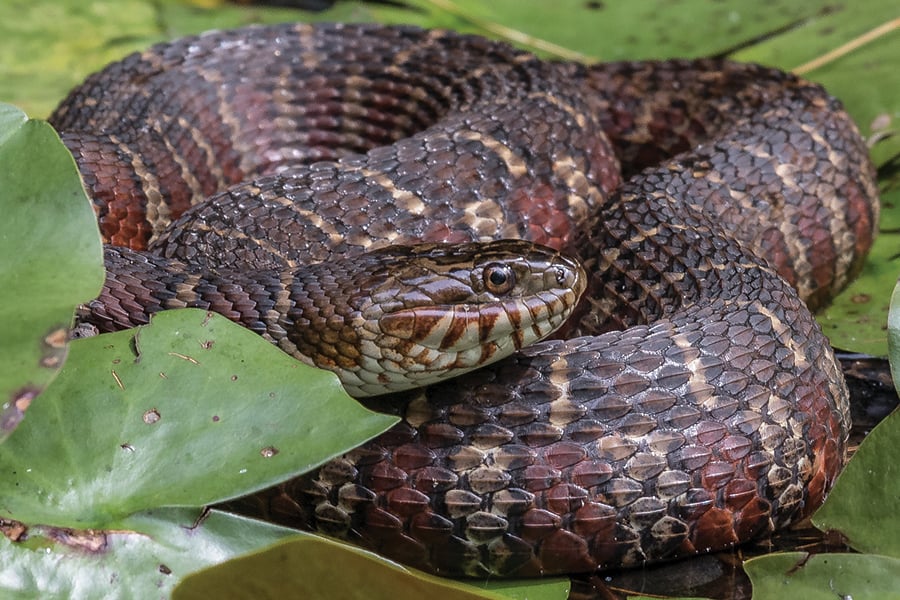
Most snakes, like this northern water snake, have “keeled” scales, each with a center ridge for better traction when climbing.
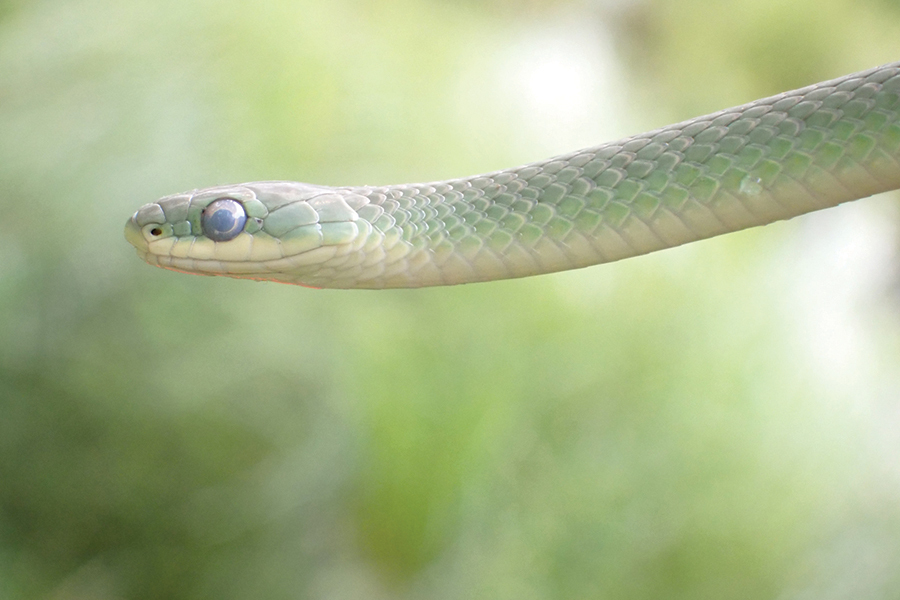
One way to tell if these reptiles have been in an area is to look for snak skins. Humans continually replace skin cells almost unnoticeably, but snakes replace theirs all at once. When new skin is ready, the old outer layer starts to loosen and fade. The snake’s eyes become opaque, and the animal becomes reclusive. It also stops eating. When it’s ready to shed, the snake rubs on rough surfaces and squeezes through tight spots until the old layer catches. The snake then slithers out of its old skin, often leaving it behind in one piece. The process can take up to two weeks, but once completed, the snake emerges fresh with vibrant colors — and a ravenous appetite.
Before molting, smooth green snakes turn pale, and their eyes become opaque.
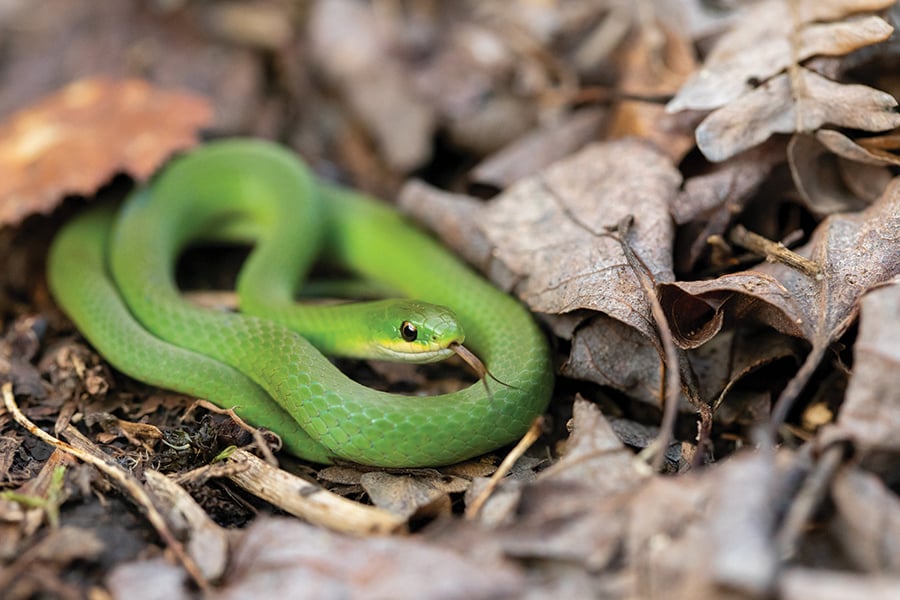
After molting, smooth green snakes emerge a fresh vivid green.
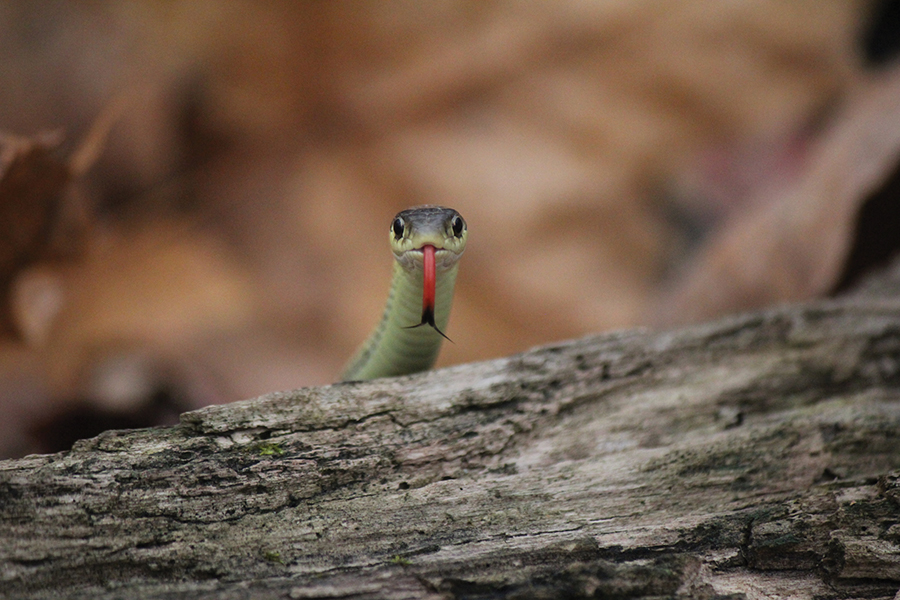
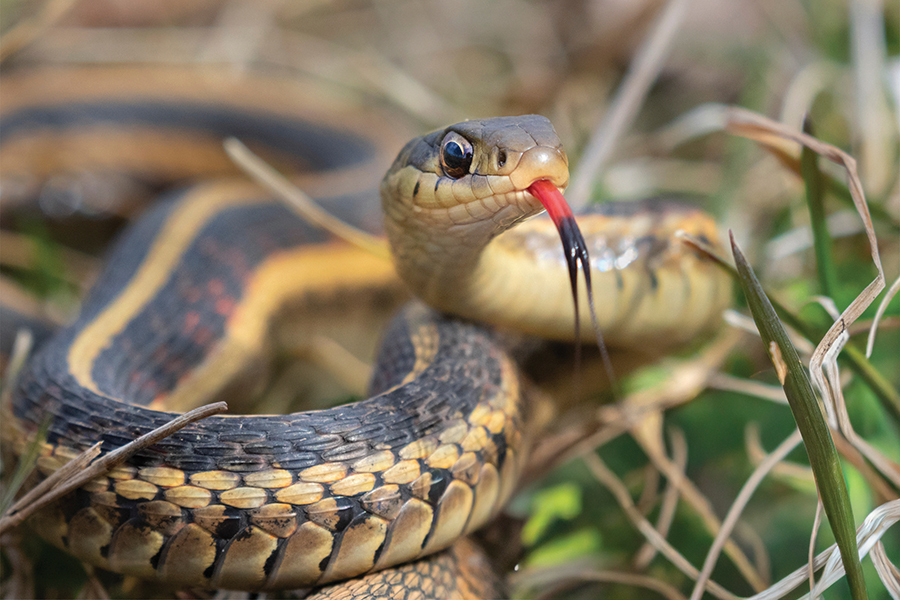
When it comes to hunting, all DuPage snakes rely on similar physical adaptations. By flicking out its forked tongue, a snake collects odors and other chemical cues in the air. A special “Jacobson’s organ” on the roof of its mouth lets the snake process those cues. As it repeatedly samples its environment and the scents get stronger, the snake is able to zero in on its prey. It doesn’t have eardrums but can detect vibrations from movement by resting its jaw on the ground. Once its prey is in its grasp, the snake can swallow it hole — even an animal ten times larger than the snake’s head — thanks to a skull and jaw connected by an elastic ligament that allows extensive separation.
This eastern garter snake is using its forked tongue to pull chemicals from the air to locate prey.
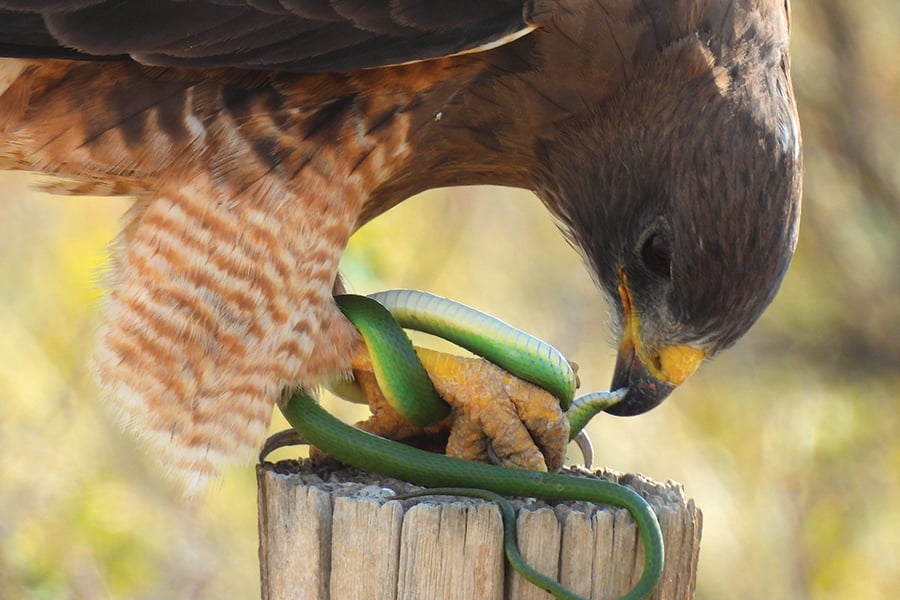
For hawks and other birds of prey, snakes are a vital part of their diets.
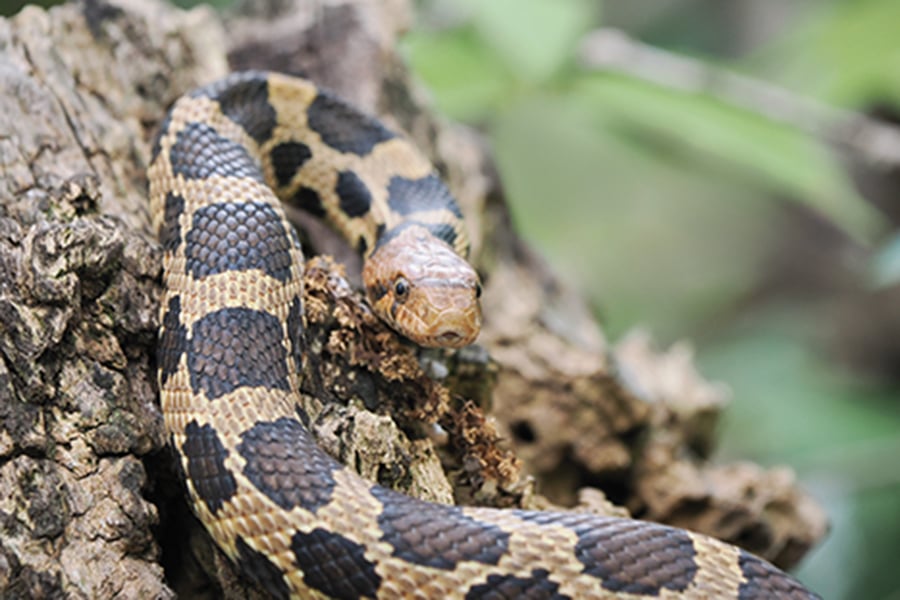
Yes, some snakes use venom to subdue their prey, but of all the snakes recorded recently in DuPage, none are venomous. (Most snakes have teeth, and some DuPage snakes produce a toxic saliva, but it’s not harmful to humans.) The venomous eastern massasauga was once a resident but hasn’t been reliably identified here in over 40 years. The similar-looking fox snake, which is known to make rattling sounds by shaking its tail in dry leaf litter, is most likely to be misidentified as one.
Snakes may not be everyone’s favorite forest preserve finds, but their ecological value cannot be overstated. As prey they sustain hawks, owls, and mammals. As predators they’re critical in preventing the overpopulation of other species. Snakes eat crayfish, slugs, worms, frogs, fish, birds, and even other snakes, but most notable on the menu are small rodents, whose populations can explode if left unchecked, starting a harmful environmental chain reaction. If large numbers of small rodents are left to overgraze on plants, other animals that rely on the same diets can decline sharply. And when rodent populations increase, so do populations of fleas, mites, and ticks and the presence of pathogens that affect humans, such as Lyme disease, hantavirus, leptospirosis, and salmonellosis. In the case of ticks, a single snake can consume thousands in a season just by eating the rodents ticks use as hosts. As eastern milk, Graham’s crayfish, Kirtland’s, smooth green, red-bellied, and other snakes become locally rare, the value of the snakes we have becomes even more noticeable.
Snakes aren’t aggressive, and they don’t want confrontation. They simply want respect and to be left alone. And don’t they deserve it?
Sometimes mistaken for rattlesnakes (and often killed because of it), nonvenomous fox snakes play a key role in keeping populations of rodents in check.
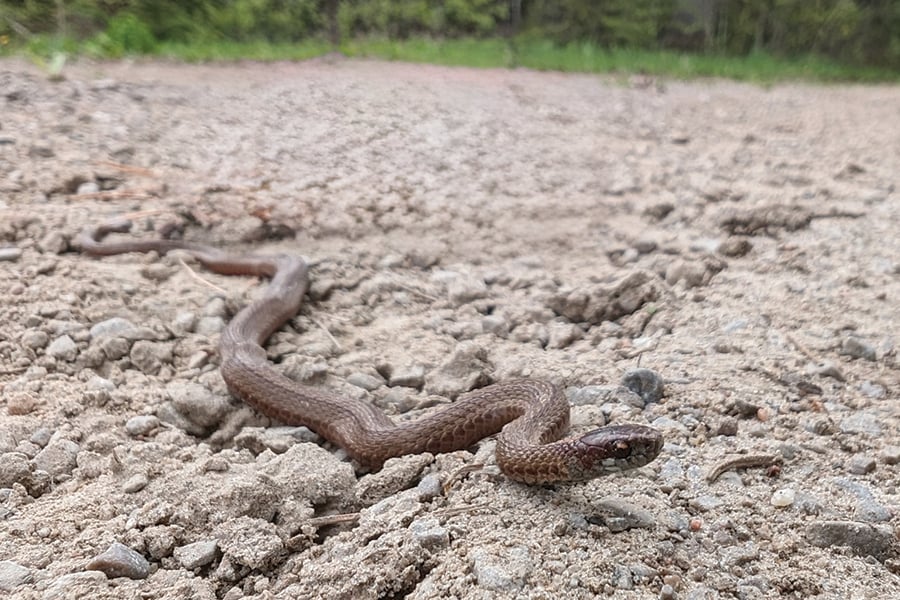
Small snakes, like this red-bellied, are often mistaken for twigs on the trails, so be on the lookout (and go slow) when biking.
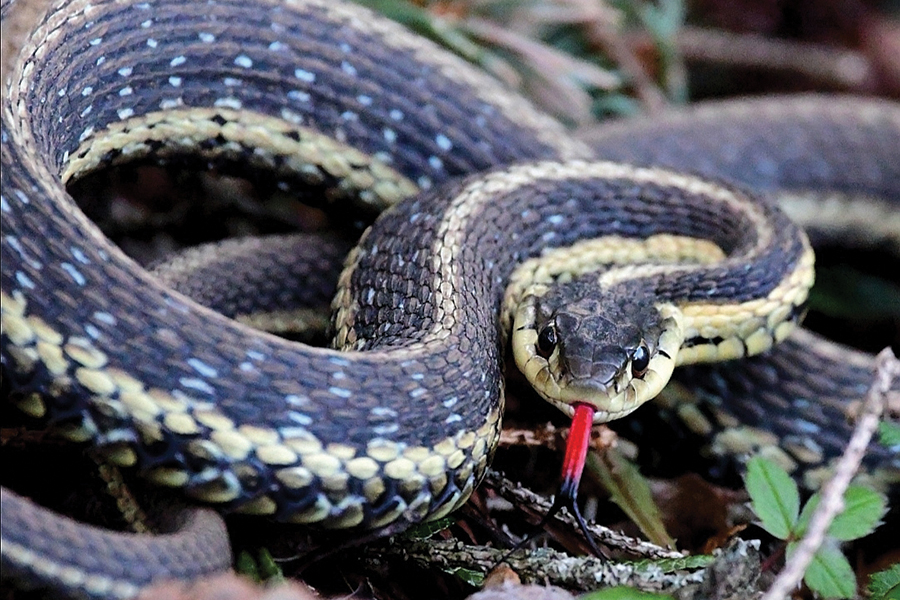
A Snake You Should Know
Common garter snakes (often mistakenly called “garden snakes”) are the species most often encountered in DuPage, in part because they live in a range of habitats from wetlands to woodlands to prairies. The county’s two most abundant subspecies — the eastern and Chicago — are a benefit to any forest preserve or backyard because they eat a variety of prey.
Garter snakes can vary widely in color. Most have three light stripes — white, yellow, or even blue — that run along the length of their black, brown, gray, or olive green bodies, which can be up to 3 feet long.
If handled, a garter snake may bite out of self-defense, but it’s more likely to just emit an unpleasant musky order, an adaptation that makes garter snakes less appetizing to hungry predators.
Following brumation a male garter snake looking to raise its body temperature may emit a pheromone that mimics the scent of a female. This attracts other males, often several at a time. As they swarm over the deceptive male, their bodies help it warm up.
Photo Credits: header ivankuzmin/stock.adobe.com; cottontail lee/stock.adobe.com; fledgling © fogshard; ducklings kristina/stock.adobe.com; phone eyewave/stock.adobe.com; fox snake © Annette; racer © Riley Stanton; northern © ronthill; hawk © Ted Floyd; eastern garter © OwenJ; red-bellied © Isabelle Summers; pre-molt © Chris Buelow; post-molt © Heather Haughn; garter © Alexis Williams.