
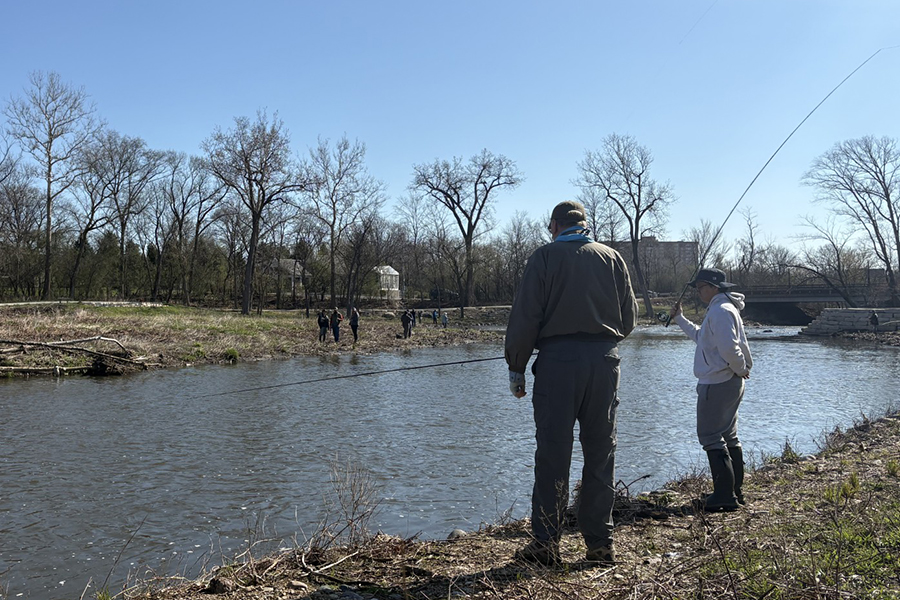
Beth Grunow stood on the south bank of Salt Creek at Fullersburg Woods in Oak Brook swinging a 9-foot, graphite pole back and forth to fling an insect imitation into the current.
Her fishing efforts and those of about a dozen others were the climax of a three-session fly-fishing program hosted by the Forest Preserve District of DuPage County in partnership with the Oak Brook Chapter of Trout Unlimited, which offers classes for adults and children throughout the year.
“I hope somebody catches something,” Grunow said between casts. “But if not, I hope they catch the love of fly-fishing.”
Grunow had fly-fished once before, in Montana, and recently received hand-me-down gear from her father, including the canvas vest she wore that sunny spring morning. She registered for the pop-up program after receiving a Forest Preserve District email about the opportunity. Her oldest son, Teddy, signed up, too. He plans to head to University of Denver in the fall to study political science and history in an area with ample opportunities to fly-fish.
The program’s first meeting was a classroom session in the event space at The Preserve at Oak Meadows in Addison. The multigenerational participants, a few sipping beverages from the adjacent Greenway Table & Tap, listened as environmental interpreters Jenny Kamm and Keriann Dubina reviewed popular fly-fishing lakes and rivers in the preserves. Though the sport is not as popular in DuPage County as in the Rocky Mountain West or Florida Keys, there are plenty of nearby places to cast a line. The two also discussed invasive species and their negative impacts on fishing and the environment.
Next, Marvin Strauch, education chair of Oak Brook’s Trout Unlimited chapter, passed around rods, reels, lines, and flies. The anglers in training, most with minimal to zero fly-fishing experience, marveled at the differences in rods used for dainty sunfish and the stiffer ones engineered to battle 100-pound tarpon. Strauch also relayed the history of Trout Unlimited and its mission of conserving, protecting, and maintaining cold water fisheries.
“I thought the classroom sessions were very informative,” Grunow said. “I enjoyed the environmental aspect of the program because people aren’t going to be able to fly-fish unless we take care of the environment.”
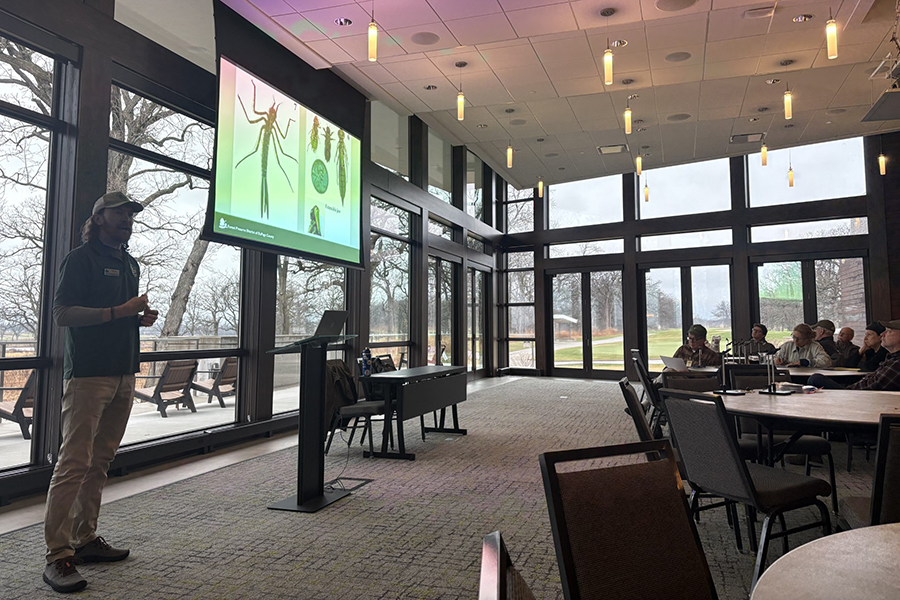
Derek Gronlund delivers a presentation on common types of fish food found in the region's rivers and lakes at The Preserve at Oak Meadows.
Two weeks later at the program’s second session, Derek Gronlund, the District’s environmental interpretation supervisor, explained how understanding what fish eat can help anglers catch them. In Salt Creek, for example, bass, pike, bluegill, sunfish, catfish, and carp eat a smorgasbord of prey, from aquatic insects (mayflies, caddisflies, and stoneflies) and terrestrial insects (grasshoppers, beetles, ants, and cicadas) to baitfish and crustaceans (scuds, sowbugs, and crayfish).
To bring the lesson full circle, three members of Trout Unlimited led a hands-on fly-tying demonstration, where students created patterns that imitated crustaceans, baitfish, and insects.
“Nature 101: Fly-Fishing in the Preserves” culminated on a chilly Saturday morning in Fullersburg Woods near Graue Mill. To kick things off, environmental interpreters Kamm and Dubina stood on a concrete platform overlooking a section of Salt Creek that gurgled over small boulders and explained the ongoing creek restoration project.
During the 1930s the Civilian Conservation Corps built a small dam on Salt Creek to create a reservoir and constructed islands that people could row a boat to for a picnic, which temporarily boosted tourism but degraded the riparian zone. The dam had created a catch basin for sediment, tires, bottles, and other pollutants.
In 2023 a project led by the DuPage River Salt Creek Workgroup removed the dam, allowing the creek to again flow freely from Fullersburg Woods to its mouth at the Des Plaines River. The project sturdied the banks and added thousands of native grasses, flowers, shrubs, and trees in the area. Crews also laid rock toes, a combination of rock and mud, to further stabilize and flatten the banks, making them easier to navigate on foot.
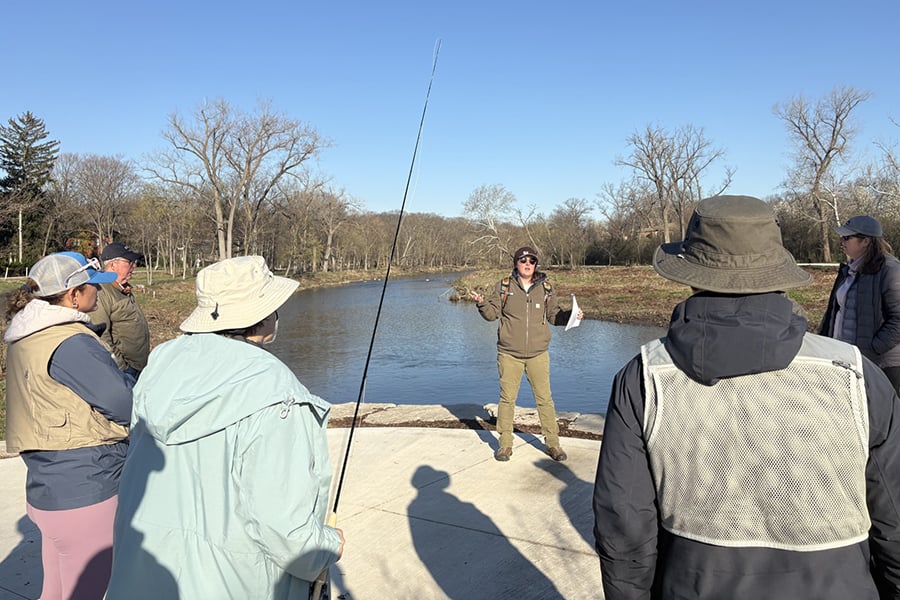
Environmental interpreter Jenny Kamm discusses the restoration project at Salt Creek.
Perhaps more important to anglers, a series of riffles and pools were instilled along the 1.5-mile section of restored creek. The bubbling riffles formed by rocks — and shaped to allow kayakers and other floaters easy passage — add oxygen to the water and create habitat for fish and their prey, and the 4- to 7-foot-deep pools provide attractive homes for game fish.
As a result of these combined improvements, eight fish species previously not seen above the dam now live in this stretch, including smallmouth bass, a favored target fly-anglers.
Casting a fly to these “fishy” sections of water requires manipulating a fly rod in a deliberate yet graceful motion, more feel than brute force. The group moved to a field near the creek, where Trout Unlimited members demonstrated how to use the weight of a fly line to propel the nearly weightless fly dozens of feet forward: Hold the rod in one hand with elbow bent at 90-degrees so the rod is parallel to the ground. Then quickly raise that hand to ear level, as if answering the phone. Pause for a second to allow the line to uncurl in the air, then move the rod forward smoothly, like hammering a nail.
Participants broke into small groups to practice as the seven Trout Unlimited volunteers coached them, offering nuanced tips and tricks to develop a smooth cast. The groups then made their way to the creek for some firsthand experience.
While Grunow dealt with the common fly-fishing act of retrieving her imitation fly from a nearby plant, a man and his son stopped on the adjacent walking path to inquire about the program. With a similar series planned for 2027 they may be next to experience the beauty, joy, and frustrations of fly-fishing.
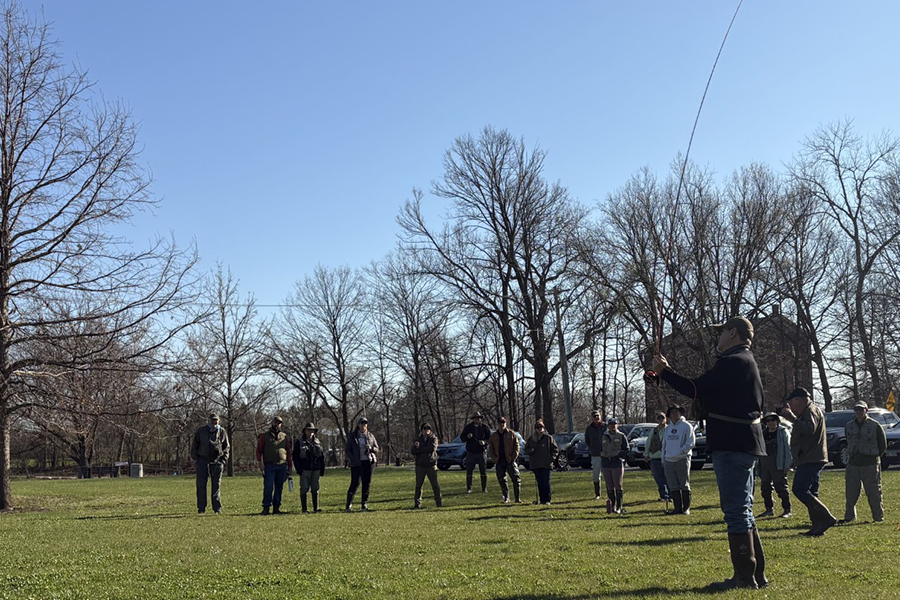
Marvin Strauch of Trout Unlimited's Oak Brook Chapter demonstrates a fly cast.